Living Members: Sharing

LM ppt background

Reading: Acts 2:44-45; Acts 4:32-37

So we have all seen those before and after diet ads. They show a picture of people like “Fred” [not his real name] before he started Weight Watchers. And then there’s a second picture taken after he’s been on the program. The change is unmistakable. In 12 months Fred lost 50kg. He’s a changed man!

biggest loser

Most people’s experience with diet, however, tends to be more like this:

robert-lost-his-glasses

In only two weeks Robert lost his glasses..

Experts are saying that crash diets do not lead to permanent change, so their suggestion is don’t throw out your old wardrobe just yet…

Moving on from diets, let’s talk church: does being part of a church change people? I read some research from George Barna this week which said that 46% of people say their lives had not changed as a result of being part of a church. Would that statistic be reflected in this church, do you think? That around half of us would say our lives have not changed as a result of being part of a church? That would be a very disturbing reality, wouldn’t it?

And it seems a picture very different to what we have in Acts 2:

Sharing…

 “All the believers were together and had everything in common. They sold property and possessions to give to anyone who had need.” (Acts 2:44–45, NIV)

This thought is extended in Acts 4:

“All the believers were one in heart and mind. No one claimed that any of their possessions was their own, but they shared everything they had. With great power the apostles continued to testify to the resurrection of the Lord Jesus. And God’s grace was so powerfully at work in them all that there were no needy persons among them. For from time to time those who owned land or houses sold them, brought the money from the sales and put it at the apostles’ feet, and it was distributed to anyone who had need.” (Acts 4:32–35, NIV)

Here’s the question: What is happening in this church that moves them to such compassionate sharing? We probably wouldn’t pick it up, but that little phrase ‘there were no needy persons among them’ would have been immediately recognised by the people Luke first wrote to. At this stage, all of them were people who identified as Jews, most of them well versed in the OT Scriptures. Many of them would have memorised at least the first five books of the Old Testament, some of them, even more than that. And a few of them would have know the entire Old Testament by heart. Their minds would have immediately gone to Deuteronomy 15, where the Lord gave commands about using wealth and freeing people in debt. As the Lord outlined how Israel was to live as people before the watching world, he said

“However, there need be no poor people among you, for in the land the Lord your God is giving you to possess as your inheritance, he will richly bless you,” (Deuteronomy 15:4, NIV)

In these few phrases in Acts 2:44, and Acts 4:34, God is telling this brand new church something very important: they are now His new people, the new Jerusalem, the new Israel, God’s new community.

That phrase “There were no needy persons among them” was a clear signal that God was living in them. Taken along with the outpouring of the Spirit into the church at Pentecost, it showed they were the temple of his Holy Spirit. It showed the Risen Christ had poured his new life into them! And they would never be the same.

God is telling this brand new church something very important: they are now His new people, the new Jerusalem, the new Israel, God’s new community

And because Christ’s new life was in them, those who had been drawn into Christ’s church considered it unthinkable that rich and poor could exist in the same community. See, when God is present in people, his compassion overflows into their lives, and from their lives into the lives of others. Through his Spirit Christ is living in these people, and has formed them into His Body. He is living in them corporately as the church, and living in them individually as his followers. They are an entirely new community, a new reality, a new spiritual entity.

Dietrich Bonhoeffer has said

Because Christian community is founded solely on Jesus Christ, it is a spiritual and not a human reality … which comes from the natural urges, powers, and capacities of the human spirit.
[Bonhoeffer, Life Together, p.21]

The church is not a human organisation, and what we see in Acts 2 & 4 is not typical human behaviour. Christ lives in the church, and his life is poured into this community by his spirit.

This sharing did not come about because they knew one another, because they’d grown up together, or because they were great friends. We saw earlier in Acts 2 this church had grown rapidly: 3000 people had been added in one day. People from all over the known world. So this church would have included some wealthy people, business people, farmers, freedmen, servants and slaves. It was an incredibly diverse community!

But look at what happens:

All the believers were together and had everything in common. They sold property and possessions to give to anyone who had need.” (Acts 2:44–45, NIV)

Now, this is not the enforced abolition of private property. We know this because many of these people still lived in their own home, we see that in v.46. We see in Acts 12 that people some time later also owned homes. We see in 1 Corinthians 1 how as the church spread into areas like Corinth, that people are still holding meetings in their own homes. People’s homes, in fact, were the primary meeting places for the church as it spread and grew. So, private property was retained, and used to bless the church.

So, this is not totalitarianism. Rather, this is spirit filled transformation of people and their community. These people have had their lives changed by Jesus, transformed by Christ. So the sharing is voluntary. And we can tell by the way the original sentences are structured that it was a regular practice, and it was directed toward poverty and need.

“They sold property and possessions to give to anyone who had need.” (Acts 2:45, NIV)

See, these Christians had made a very conscious decision to use their money and wealth to show the grace of Jesus Christ and His Kingdom. And all it took for this to happen, it seems, was for someone to have a genuine need. Followers of Jesus would volunteer cash, or goods that could be sold, or shared, so the needs of that person to be met.

Of course, there is a caveat: this is not about throwing good money after bad, or rewarding poor choices. God does not want his people to sell their stuff so someone can use the money to support their substance abuse, or their gambling habit. Substance abuse and gambling are destructive behaviours. This sort of sharing would have been applied in a way that the restoration of the Kingdom, the values of heaven, would have been brought to expression. Both giver and receiver come under the same transformation.

It is an incredibly attractive picture, isn’t it?

Here’s the question: Would a church like this be a church you would like to be part of?

Materialism

Maybe you’d want to be part of that kind of community. At least on the receiving end. But would you want to be one of the givers? Would you be prepared to share something of your wealth or your assets to assist the genuinely needy?

I think this is a challenge for us, because we place so much emphasis on our possessions. Our struggle is not that our goods are bad. It’s more that it’s so easy to make them gods.

Tim Keller reminds us:

Sin isn’t only doing bad things, it is more fundamentally making good things into ultimate things

If we make good things ultimate things, they become our idols. They take the centre of our lives. They occupy our vision, they determine our gals and values. But when Jesus is Lord of your life, he occupies that place and hold those prerogatives. He is Lord of all, and as Lord of all he intends to cast every idol out.

Jesus in your heart changes how you use what is in your hands. When Jesus is your God, he’ll change how you see your goods.

This becomes more complicated the wealthier our society becomes. Go back generations, and there was less focus on what people had, because so few people had disposable wealth. Today in Australia, we are more wealthy than most of the world, and yet it’s hard for us to contemplate this kind of sharing. It shouldn’t be, really, because whether now, or 200 years ago, or 2000 years ago, Christians have always said that Jesus is their rock.

On Christ the solid rock I stand, all other ground is sinking sand.

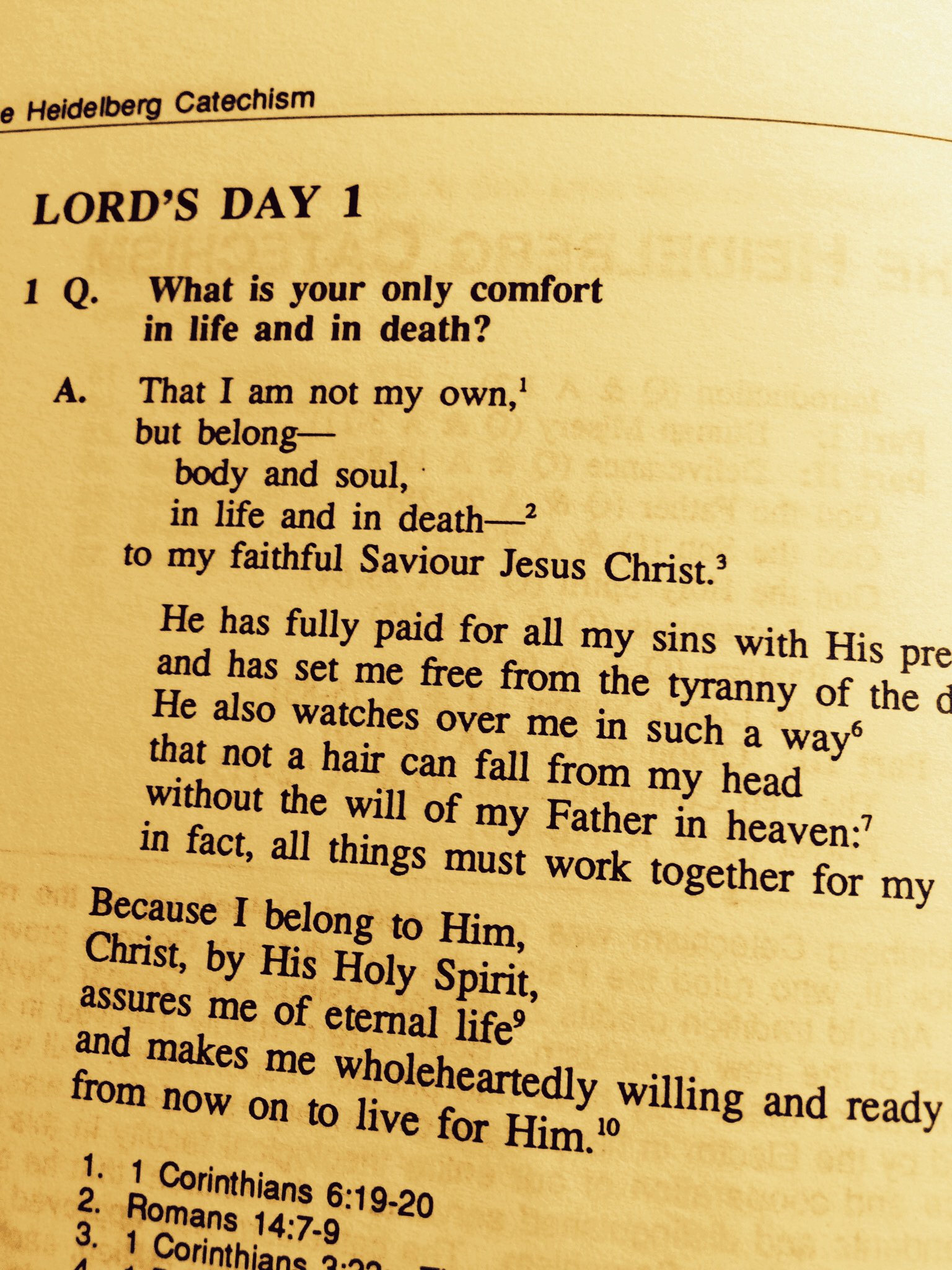
Christians have always said that their only comfort in life and in death, is not in what they own, but in that they are not their own, but belong, in body and soul, in life and in death, to the faithful Saviour, Jesus Christ.
IMG_0285

Because Christ holds me securely, I can hold other things loosely. Because I am treasured by Christ, I can treasure another reality:

““Do not store up for yourselves treasures on earth, where moths and vermin destroy, and where thieves break in and steal. But store up for yourselves treasures in heaven, where moths and vermin do not destroy, and where thieves do not break in and steal. For where your treasure is, there your heart will be also.” (Matthew 6:19–21, NIV)

Our treasure is heaven: that is, bringing God’s reality to expression in our lives. Our treasure is to live put that reality that we are seated in the heavenliness with Christ even now (see Colossians 3:1-4). We are living the life of our new citizenship in heaven.

Because Christ holds me securely, I can hold other things loosely

And look at these Christians! This sharing is a clear indicator that they are doing just that!

Gospel Transformation

See, something has happened and it has changed these people forever. And the thing that has happened is this: Jesus Christ is risen, and he is living in these people. That’s what Paul says in Romans 4:

“We were therefore buried with him through baptism into death in order that, just as Christ was raised from the dead through the glory of the Father, we too may live a new life.” (Romans 6:4, NIV)

That’s what has happened! They have been made alive forever in the resurrection of Christ! They have been drawn into his new community, into his church! They are his new people. In that sense the change that Jesus is working in them is already becoming visible. Jesus is living in them through his spirit, and he is changing they way they lived, and the values by which they lived their lives.

Think of it this way:

Imagine you had a rich uncle. You were his favourite niece or nephew. Imagine you uncle has died, and you’ve just had news that he’s left several million dollars to you in his will. And you will receive that inheritance in 3 months time. October 19, 2015. Do you think your life would be any different? Of course it would! Even though the inheritance had not been fully received, you’d start to make some changes immediately: you would tell people your good news, and the reality of that good news would change your disposition and your behaviour! How could it not do so?

See, this is what we mean when we say we are living a new life. Something has happened: we have the life of Christ! We have been given an inheritance that can never perish, spoil or fade! And while we don’t have its total consummation, the fact that we have this inheritance makes a difference today, in the here and now.

These people did not have its total consummation: but Christ living in them changed how they lived to such an extent that they used their possessions to bring him glory and to help the needy. They did this knowing not only that something had happened, but that something else was yet to happen. Christ would return, and bring the new heavens and the new earth. And until that happened, their calling was to live the values of that coming existence in their here and now.

It may be true that we lose out on something of the power of Christ’s new life because we do not intentionally live in his changed reality. Because we live like we do not have the inheritance he has given.

R Kent Hughes says

So many people never know the joys of Christian fellowship because they have never learned to give themselves away.

With this in mind, it’s not hard to see how sharing like this is one of the most powerful evidences of the presence of the Holy Spirit. That’s exactly what we read in Acts 4

“…God’s grace was so powerfully at work in them all that there were no needy persons among them…” (Acts 4:33–34, NIV)

…so powerfully at work in them… – it’s not just a rhetorical expression. It’s the new life of Jesus Christ coming powerfully to expression!

I am incredibly challenged by this. I don’t think I am that driven by possessions. Just don’t ask me if you can borrow one of my bass guitars… Then again, if there was a real need, would I have the desire to put one or two on eBay and give the proceeds toward that need?

I started today by referring to research which said 46% of people were unchanged by being members of a church. Do you think people in the Acts 2 church would have said that? Far from it.

Do you think you would say that if such grace, such spirit power were flowing through you? Far from it.

The reality is, we all want to be this kind of church. We all want to be living members of precisely this kind of community.

Now, I do not know your need, or the extent of your wealth. But perhaps this message is challenging you to step up: “God has blessed be richly, I have some some money, and if there’s ever some genuine need, let me know…” Or maybe you’re being challenged from the other side of the ledger:  “I am so on the breadline, I have been through this awful financial catastrophe, and I don’t know what to do…’

Come, let us pray about it, let’s work this out like God’s people should. Jesus says: it’s time for us to reorient our approach to wealth and material possessions. And if we do, through the grace of Jesus, in the power of his Spirit, our lives will change, our church will change, and our sharing will bring powerful witness to the Christ, who changes everything.

[download sermon audio here, or via iTunes Podcast]

Podcasts now available

image

Sermon & Study podcasts are now available from iTunes and the Gateway Community Church.

We hope the addition of audio files will enhance your opportunities to study God’s Word and be increasingly transformed by it with the members of your discussion group.

Dave Groenenboom

Living Members: Devoted to the Fellowship

image

Reading: Acts 2:1-13

Primary text: Acts 2:42

As I look at the these few verses, it struck me again just how beautiful this church is. This Christian community radiates with the love and transformation of the Gospel of Jesus.They were devoted to great teaching, good fellowship. They were filled with awe, and wonderful things were happening. They met together each day. They were generous to one another, and compassionate to the needy.

It is an amazing picture, right? Why is that? What is happening?

God and fellowship

God is busy! God is showing us something of his nature! Interesting, because you normally would not say that about the church, would you? That it shows us something about God? We tend to think of the church as a human thing. People attend. People serve. People worship and engage in mission. But God? Why would we say the church shows us something about God?

Think of Jesus in the Garden:

““My prayer is not for them alone. I pray also for those who will believe in me through their message, that all of them may be one, Father, just as you are in me and I am in you. May they also be in us so that the world may believe that you have sent me. I have given them the glory that you gave me, that they may be one as we are one—” (John 17:20–22, NIV)

Jesus’ prayer shows us how intimacy of fellowship characterises the Trinity. Father, Son and Spirit are one. And in John 17, Jesus prayed that same oneness will be evident in the fellowship of his church.

Or think of creation:

“…God said, “Let us make mankind in our image, in our likeness, so that they may rule over the fish in the sea and the birds in the sky, over the livestock and all the wild animals, and over all the creatures that move along the ground.” So God created mankind in his own image, in the image of God he created them; male and female he created them.” (Genesis 1:26–27, NIV)

Think about that: God created mankind in his own image, in the image of God he created … them. So, there is something about fellowship, about community, about people being connected together, that reflects the image of God.

We all hunger for relationship

This is not just a point of theology. It explains something we all know at the deepest level: We all hunger for relationship. We all crave a deep intimacy with others. We all want to belong. We all long for relationship which is wonderfully secure and profoundly fulfilling. It’s why no one is satisfied with a lousy marriage or a troubled friendship. We are created for relationship, for fellowship, for community.

What we have before what we do

This is why Jesus’ first act after returning to the Father was to create a community, his church, and pour his spirit into it.

Think about that: On that day, there were God fearing Jews from every nation under heaven. Parthians. Medes. Elamites. People from Mesopotamia, Judea, Cappodocia, Pontus, Asia, Phrygia, Pamphilia, Egypt, Libya, Rome, Crete, Arabs. They all heard the wonders of God being proclaimed in their native language by uneducated people who had never learned those languages.

What’s happening? What’s going on? God is busy! And the barriers between people are being broken down by the Holy Spirit. Perhaps the most glaring example of human division – language barrier – is overcome as the Spirit is poured out. In that glorious outpouring Babel itself is momentarily overcome. The curse of human enmity is dissolved as Jesus Christ pours his Spirit water into his newly formed community, the church.

So in those few words in Acts 2:42 we see a relational miracle taking place. God reveals his nature and his plan to overcome division and enmity. He does it through Jesus’ death, rising and rule. And the result?

“They devoted themselves … to the fellowship…” (Acts 2:42, NIV)

There is an important implication: fellowship is what we have before it is anything we do. It’s good for us to remember this. We tend to see fellowship as something that happens when we share a coffee after church, something which happens around a meal, or a congregational event. The bible tells us fellowship is considerably more profound.

This is illustrated by how the word koinonia is often used in the New Testament. The following passages all use the Greek word koinonia – which Acts 2:42 translates as fellowship:

“In all my prayers for all of you, I always pray with joy because of your partnership in the gospel from the first day until now,” (Philippians 1:4–5, NIV)

That word ‘partnership’ is the Greek word koinonia. Of course, it may refer to how they work together in the Gospel, but primarily it is more that they are together in the Gospel, and this forms the basis for their collaboration.

Or have a look at what Paul write to Philemon;

I pray that your partnership with us in the faith may be effective in deepening your understanding of every good thing we share for the sake of Christ.” (Philemon 6, NIV)
It’s very clear there, right? There is partnership – koinonia – in the faith, and it deepens what they share.

Or 1 John 3:

“We proclaim to you what we have seen and heard, so that you also may have fellowship with us. And our fellowship is with the Father and with his Son, Jesus Christ.” (1 John 1:3, NIV)

God’s people are connected in Christ. They even have fellowship with the Father and the Son. They have fellowship with one another. They share an essential unity, a fundamental, intrinsic togetherness.

How has this connection come about? It has come about through the cross of Jesus. We have those very familiar words of Paul as he teaches the Corinthian church about the nature of the Lord’s Supper:

“Is not the cup of thanksgiving for which we give thanks a participation (a koinonia) in the blood of Christ? And is not the bread that we break a participation (a koinonia) in the body of Christ?” (1 Corinthians 10:16, NIV)

The koinonia referred to here is not primarily something they do, it is something the share by reason of the fact that they are in Christ. Jesus has conquered the fall, human sin, in his Cross. In this saving act he has drawn people together, ingrafted them into his vine, made them members of his body. At that very basic level, fellowship and unity is established.

Look at the entire history of humanity and you find a glaring inability to create true community. Human history is a chronicle of tension, violence, and death. The creation harmony of Adam and Eve is followed by the fall, with the immediate result of jealously, enmity and death between Cain and Abel. So it began, and so it continues today.

But look what happens through Jesus: Through his death, rising and rule a new community is formed, and they love each other! They serve each other! They cannot get enough of each other! The church, this fellowship, is God’s answer to all our enmity, division and loneliness! The church is God’s plan to bring new humanity to his world!

That’s what Paul says in Ephesians 2

“For he himself [Jesus Christ] is our peace, who has made the two groups one and has destroyed the barrier, the dividing wall of hostility, by setting aside in his flesh the law with its commands and regulations. His purpose was to create in himself one new humanity out of the two, thus making peace, and in one body to reconcile both of them to God through the cross, by which he put to death their hostility.” (Ephesians 2:14–16, NIV)

Jesus Christ has destroyed every barrier, and is at work through his Spirit to overcome everything that separates us. And the place God wants you to see this most of all, that people can get along wonderfully, that hurts can be overcome permanently, that none of us is better than the other, is right here: this church, our church.

Fellowship: Living the dream

See, God’s plan is to make the church the best fellowship, the best community on earth. This has always been his plan. Through Israel he was saying to a watching world, “You want to see a place where you can trust people again? Where there’s no threat of violence? Where people get along, where you know people love you and care for you, where if you’re financially busted they will help you out, where if you’re hungry there will be food, where if you’re lonely, there will be friends, where if you have lost hope in humanity, you will find it restored? Then look at my people, my treasured possession, my kingdom of priests, my holy nation (see Exodus 19:6).

When everyone else is looking after number one, in this church they are one, so deeply, so lovingly, they devote themselves to the fellowship. They are one. They are united in Christ. They have fellowship with the Father. There is fundamental unity. There is family.

We read how these people in Acts 2 had everything in common. Their outlook. Their vision. Their mission. We are told that 3000 joined the church at Pentecost, yet with such a huge group, they still shared life together. They met in one another’s homes. They were overjoyed to be together.

Now, we live in different times and a different culture, true. But I believe there’s a desire for us to do more life together, to be just this kind of radical community.

You know, as we move into the future, what my biggest prayer is for Gateway?

It’s not that we have all seats filled. It’s not that we have a big fat black figure bank balance. It’s not that we have terrific facilities and we get to stop juggling rooms.

My prayer is that people will come in here and feel their burdens lifted.

My prayer is that when people come here they will have a sense of relief, not that they finally can go home, but relief that they have come home.

My prayer is that when people come in here they will have a sense of meeting with their closest friends, that they’ll feel new life rippling through the relationships they have with everyone here.

My prayer is that when people come together here they’ll be with people they can cry with, laugh with, face their fears with.

That when a service is finished, we won’t just be talking together or sharing a cuppa, you’ll see people praying together, embracing one another in love, going eyeball to eyeball with the grace of God.

My prayer is that this community will be known for accepting outcasts, the lonely, refugees, people on the fringe. And we won’t look at them as if they are freaks, or threats, but that we’ll find ourselves incomplete until such people are routinely part of us.

My prayer is that with each new day, each new week, every month, for years to come, this community will look less like us and more like heaven.

How will this happen?

It will come about as the power of the risen and ruling Jesus is poured into us through his Spirit. It will come as wel place ourselves more and more under his Word, as we are devoted to the apostles teaching, and devoted to bringing this new community to life, to his glory.

The question you need to ask yourself is this: What can you do to be devoted to the fellowship?

First, thank Jesus, that in his death, rising and rule he has overcome every barrier. Praise God for the gift of His Spirit who draws us to Christ, and through whom we are grafted into Jesus the Vine.

Second, engage: Prayerfully devote yourself to the fellowship. Recommit to weerily worship with God’s people. If you’re not part of a Home Group, join one and love everyone who is part of that group. It must amaze us when God places such a high value of fellowship in the early church, that we tend to minimise its importance. John Wesley has said, perhaps for this reason, “There is nothing more unchristian than a solitary Christian.” God is calling you to re-engage with his church. Obey this call.

Third, share the love: Do whatever you can to bring the fellowship you have to radiant expression in your church. After the service is done, we tend to chat with the people we know and love. You can do that anytime. Today, there are people present whom you don’t know, or with whom you’ve not spoken too much. Talk with them. Take the first step of grace, and speak with those whom you don’t always speak with. Why not offer to pray for them, ask their needs – how can I pray for you? I do this occasionally with people, and sometimes when I do a thought – or is it a vision? – flashes through my mind: imagine if lots of people were doing this every time we meet! That as well as good coffee, there is some great koinonia – palpable signs of the body of Christ praying for, encouragin, and loving each other, being devoted to fellowship. How good would that be?

Friends, in Christ you are one, now be one to His glory. Devote yourselves to the fellowship.

Living Members – Apostolic Teaching – Group Study Questions

Read Acts 2:42-47

What’s the first thing that comes to mind when you hear the word ‘devotion’?

Read the following passages, and distill their core elements of Apostolic teaching

Are there any aspects of Apostolic teaching that is not covered by these verses?

What are they, and where do you find them in Scripture?

To what extent is it possible to accept apostolic teaching in an intellectual sense only?

Go around the room and give your definition of the word ‘devoted’

Does your definition of ‘devoted’ describe your approach to learning from Scripture?

What might account for the ‘gap’ between your definition of devotion and your practice of being devoted to apostolic teaching?

What would have to happen in your church community to bring this sort of devotion to greater expression?

In closing: Spend some time in prayer asking God to help you work toward greater devotion to apostolic teaching in your church

Feel free to leave comments as feedback…

Living Members: Why Apostolic Teaching Matters

Bible page

I learned to cook over an open fire when I was am member of the scouting movement. Later in life I developed a taste for Italian. Then, when Leonie and I were engaged, we did some fundraising by making Mexican Dinners for several couple at a time: we did the work, they enjoyed the meal, the school received the money.

These days, things get more interesting because I experiment a little. I have this apron which says “Real Men Don’t Use Recipes”. It reminds me of the first time I baked bread: When you bake bread you use a little salt. Typically, a teaspoon. The problem was that I read ‘tsp’ as ‘tablespoon’, so the bread came out tasting more like cooked play dough. I still made the family eat it. It was OK: They stopped drinking after a few days.

It is important to follow the recipe, right? A good recipe combines the finely balanced relationship between all the essential ingredients. You follow the recipe well, and you end up with a feast!

Apostolic Teaching

What if there was a recipe for a living church? A healthy church? A church that was like a good meal, or a feast? What would the ingredients be? While I’d like to avoid the idea of a ‘cookbook’ for the church, it just so happens we read about those ‘healthy church’ ingredients here in Acts 2.

And the first ingredient Paul mentions is found in v.42

“They devoted themselves to the apostles’ teaching and to fellowship, to the breaking of bread and to prayer.” (Acts 2:42, NIV)

Before we get to what that teaching was, we need to identify who the Apostles were. On occasions, the New Testament uses the term ‘apostle’ in a wider sense to refer to someone who is sent as a special messenger. Typically, however, Scripture typically uses the term in a very narrow sense to refer to a small group of people who

  1. Had been personally taught by Jesus
  2. Were eyewitnesses of the resurrection

This is critical: because the Bible places great importance on the teaching of these men. And it does so because God wants us to know that their teaching has not been changed over time. Like witnesses in a courtroom, the teaching of the apostles is totally reliable and absolutely trustworthy.

So, if apostles are no longer with us, how can we be devoted to their teaching? We do that by reading their writings, as they are recorded in the Nee Testament. We may not have those men, but we do have their words.

There are many examples of apostolic teaching in the New Testament. Here are some examples:

The Apostle Peter, speaking on the day of Pentecost, preaches the apostolic Gospel:

““…Jesus of Nazareth was a man accredited by God to you by miracles, wonders and signs, which God did among you through him, as you yourselves know. This man was handed over to you by God’s deliberate plan and foreknowledge; and you, with the help of wicked men, put him to death by nailing him to the cross. But God raised him from the dead, freeing him from the agony of death, because it was impossible for death to keep its hold on him.” (Acts 2:22–24, NIV)

Or we have the Apostle Paul in 1 Corinthians 15

“For what I received I passed on to you as of first importance: that Christ died for our sins according to the Scriptures, that he was buried, that he was raised on the third day according to the Scriptures, and that he appeared to Cephas, and then to the Twelve.” (1 Corinthians 15:3–5, NIV)

Or the Apostle Paul again in 2 Corinthians 5

“…if anyone is in Christ, the new creation has come: The old has gone, the new is here! All this is from God, who reconciled us to himself through Christ and gave us the ministry of reconciliation: that God was reconciling the world to himself in Christ, not counting people’s sins against them. … God made him who had no sin to be sin for us, so that in him we might become the righteousness of God.” (2 Corinthians 5:14–21, NIV)

Even if we consider the truths expressed in those three examples, we cover such themes as: Jesus is True Man and True God. Jesus Christ was crucified for sin. He became sin for his people. He was raised from the dead on the third day. His death reconciled people to the Father.

What we find is that the apostles were tasked by God Himself to communicate core truths like these to the church and to the world.

We see this in what the Apostle Paul writes to Timothy:

“… the things you have heard me say in the presence of many witnesses entrust to reliable people who will also be qualified to teach others.” (2 Timothy 2:2, NIV)

Some years later, and after the New Testament witness had been settled, such core Apostolic truths were formulated into statements of faith which were used as teaching tools by the church. Perhaps the most well known of these is the Apostles Creed (c.325 AD):

I believe in God the Father Almighty, maker of heaven and earth
And in Jesus Christ, His only Son, our Lord
Who was conceived by the Holy Spirit
Born of the virgin Mary
Suffered under Pontius Pilate
Was crucified dead and buried
Having suffered the torments of hell
The third day He rose again from the dead
He ascended into heaven
And is seated at the right hand of God the Father Almighty,
From there he shall come to judge the living and the dead.
I believe in the Holy Spirit
The Holy catholic church
The communion of the saints;
The forgiveness of sins
The resurrection of the body
and the life everlasting

So, we can say that being devoted to apostles’ teaching involves committing to a body of truth. That is widely recognised. What is not always equally recognised is that being devoted to apostolic teaching is more than adopting a body of truth or giving assent to it. There’s more to being a Christian than simple working your way down the apostolic truth checklist:

Believe God the Father, Creator – check

Believe Jesus is his son – check

Accept the virgin birth – check      … and so on.

There’s more to being a Christian than agreeing to truth about Jesus: Christians are not only informed about Jesus, they are transformed by Jesus.  This is because being committed to apostolic teaching demands a faith commitment to Jesus Christ.

  • Apostolic teaching says Jesus is the Son of God: he demands your allegiance.
  • Apostolic teaching says Jesus died on the cross for sin. You are a sinner, and you cannot save yourself: You need to respond to his sacrificial death.
  • Apostolic teaching said Jesus rose from the dead: you need to bow the knee before his victorious majesty.
  • Apostolic teaching says Jesus lives in people of faith through his Spirit. He empowers them for life and obedience: you need to believe that and live in his power.
  • Apostolic teaching says he’s coming to judge the living and the dead: so, you’ll want to meet him as your Saviour and Redeemer, and not as the one who says ‘depart from me, I never knew you.”
  • Teaching is not just about knowledge. It is also about personal faith, trust, and belief.

So, this NT church devoted itself to the apostles’ teaching, not merely to know about Jesus, but to grow in him. To express their faith in him. To give expression to their relationship with him. Consequently, if we want to be a living church, faithfulness to apostolic teaching is going to be an essential ingredient of who we are and what we do.

As John Stott has written,

Fidelity to the apostles’ teaching is the very first mark of an authentic church.

Devoted Themselves

Once again, have a look at v.42:

“They devoted themselves to the apostles’ teaching and to fellowship, to the breaking of bread and to prayer.” (Acts 2:42, NIV)

The way the sentence runs shows us they were also devoted to the fellowship, to the breaking of prayer, and to prayer. Today, of course we’re talking about being devoted to the apostles’ teaching.

Let’s think about that word ‘devoted’. It can have a range of meanings:

To adhere to something: to stick with something

To persist in – despite any difficulty, inconvenience or opposition

To be faithful to – like to a person, a spouse, to have relational integrity

To hold fast to something – the opposite of getting blown about by the wind

In each of those examples we can envisage a threat, or a challenge, or simply pressure or temptation to let go, to go soft, not to bother. But the New Testament church would have none of that. Despite great pressure, opposition from the religious leaders in Jerusalem and persecution by the Sanhedrin they nevertheless devoted themselves to the apostles’ teaching. They adhered to what the apostles taught. They remained faithful to the message of Jesus.

Such devotion was a primary means of declaring their faith in Jesus. As they sat under the apostles teaching they learned more about their Saviour. They understood more about their mission, their calling as his people. They had a clearer vision of what they were called to do.

Today, we need to look at the church, and consider whether our lack of capacity to engage with our world, or to answer h growing numbers of militant atheists, or simply to know how to share our faith stems from a lack of devotion to the apostolic Gospel. We need to ask whether some of growing disconnect between what we believe and how we live might be attributed to our lack of devotion to apostolic teaching. Conversely, if we want our church to be healthy, wholesome, primed and pumping with Jesus’ life, we need to rediscover, recommit to, and at very least, passionate reaffirm our devotion to apostolic teaching.

Challenge of credo

Here’s why it’s important: Last week we considered a church which is radiant with the risen life of Jesus, and holy and blameless in his love. Today all of us must ask: do we really want to see our church become radiant like that? The question may be more critical than what we realise. Consider what happens when a church loosens its grip on apostolic teaching:

  • Children won’t learn about Jesus
  • People won’t hear about Jesus or celebrate the significance of his death, rising and rule
  • The church will have no witness, and nothing to offer to the world around it
  • Within a generation or two, the church will either die, or be gathered around some false cause or idol

Who would want that?

So, once again, the question: Are we hungry for apostolic truth? Are we hungry to see our church shine in this truth? Are we hungry to learn? Then you need to be devoted to apostolic teaching as we find it in Scripture. We will need to stick with it, adhere to it, be faithful to it, hold fast to it. And that  will require recommitment, change and endurance.

If our devotion to the apostles’ teaching is to grow, then each of us needs to ask some questions:

  • How can I place myself in the best contexts to learn the apostolic Gospel?
  • How can I help others understand more of about apostolic teaching?
  • Where are the best places to get together with others to encourage them, support them and find for myself the necessary support to follow apostolic teaching?

You’ll note I am talking about contexts with others, because the best growth does not come on your own, or with a book, or via downloaded audio, or through video on your technology. In Acts 2 this devotion was expressed together, in community. And while I will spend more time on the idea of fellowship next week, allow me just to note how in the Greek word for ‘on your own’ is ἴδιος “idios.” Now, all you have to do is change one letter at the end, and what do you have? That’s right: “idiot”. Enough said, maybe. The Ancient greeks knew that a person on their own was not a good thing. They knew that a person cannot learn or grow effectively on their own. They pretty much were saying, ‘only an idiot would do that…”

Now, that doesn’t mean you should never have a personal quiet time or never do personal bible reading. To say would be ridiculous. But it does mean you can’t rely on your own personal intake of information to grow the way the Lord wants you to grow. So, we are going to be devoted to apostolic teaching, we will need to consider how to do that in community, together.

So: back to the question: what are the best contexts for you to meet with others and learn together how to follow Jesus?

Well, it’s contexts like today: worshipping together, sitting under the word, praying together. It’s Home Groups, where you can process material from Sunday, where you can pray together more intimately, where you can do life and share a meal and wrestle with apostolic truths together.

Here at Gateway Community Church we have three healthy home groups here at GCC. We have enough people for three or four more. Are you part of one? You should be! It’s one of the best ways we can grow in our devotion to teaching. If you opt out of things like home groups, or loosen your commitment to church, you weaken the church and you weaken yourself.

In addition to our weekly meetings and home groups, we as a church also need to find other teaching contexts to deepen our understanding of apostolic teaching. We could consider, for example

  • GCC 101 – where we can consider some of the broader themes of apostolic teaching in Scripture and explore their impact on faith, life and mission
  • Picking up a few units of the Reformed Theological College’s excellent raft of off distance eduction. These are tremendous ways to explore scriptural depth with theological rigour
  • Improving our processes of discipleship, where we do more to develop people’s gifts, where we empower passionate preaching, and develop contexts which clarify and affirm apostolic teaching

The reality is, Jesus built his church on the foundation of apostolic teaching. The better the foundation, the more durable and radiant the structure. May God give us the grace to rise to the challenge and learn from our glorious Saviour as we do so.

What Jesus Thinks About the Church – Study Group Questions

Living-Members-Promo

Read Ephesians 5:21-33

Click this link to re-read the sermon 

Discuss

  • To what extent do you think our consumer driven culture interferes with how we connect with our local church?

Read Ephesians 5:25b-27

“…Christ loved the church and gave himself up for her to make her holy, cleansing her by the washing with water through the word, and to present her to himself as a radiant church, without stain or wrinkle or any other blemish, but holy and blameless.

  • What factors influenced Jesus’ decision to love the church? Find passages elsewhere in Ephesians to confirm your answer
  • What are the key implications of Jesus’ love for the church, and how does this impact you?
  • In Ephesians 5:25-27, is the emphasis more negative or positive, and what does this mean for
    • How we view the church?
    • How we engage with the church?
  • Looking back over your life, who has shown you the greatest example of what it means to love the church?
  • What are three things your local church could do differently to bring this powerful picture to greater expression?
  • Spend some time praying for what you have just discussed, asking God to work in you to bring these things about.

What Jesus Thinks About the Church

LM ppt background

“…Christ loved the church and gave himself up for her to make her holy, cleansing her by the washing with water through the word, and to present her to himself as a radiant church, without stain or wrinkle or any other blemish, but holy and blameless.” (Ephesians 5:25–27, NIV)

Consider this question: Are you are worshipper or a consumer?

When you go to your local shopping centre, you are a consumer. You buy your coffee from Jamaica Blue, your Burger from Grill’d, Sushi from the Sushi Palace, and clothes form Kathmandu. You are the consumer, they are the providers. Our culture revolves around this dynamic.

Part of the challenge for us today is that we may be tempted to see our own church the way we see the local shopping centre: as a provider of services. You go to that church for Sunday worship, youth programs, children’s programs, and home groups. In one sense, it’s understandable: these programs are how we connect with our local church community. It can also be a problem: the more we think this way, the more we cease being worshippers and start being consumers, and we start to choose church because of what it can do for us.

Imagine if we chose our spouse like that: for what she can do for us. Imagine the night we go out on our first date we saying something like this:

OK, so here’s the deal. I’m looking for someone who can cook like Masterchef, look like Scarlett Johansen, get the housework done, parent the children, walk the dog, decorate the home, and snuggle up like (use your imagination) … so if that’s you, I reckon this will work fine. But if the day comes when a large portion of that is not happening, you need to know that I will be looking around. My season of love will have come to an end, and I’ll be entering into a season of someone else…

Guys, you say that to your lady, how’s that going to work for you? Even so, many people seem to approach the church that way. And shouldn’t be surprised to find them dissatisfied and frustrated with the church. But let us not focus on what some people might think. Let’s consider what Jesus thinks about the church. This section in Ephesians demonstrates this very clearly. It’s written about husband and wife relationships, sure, but the model for those relationships is how Jesus views the church. So what is that?

Christ loves the church

The short answer: Christ loves his church!

“…Christ loved the church and gave himself up for her to make her holy, cleansing her by the washing with water through the word, and to present her to himself as a radiant church, without stain or wrinkle or any other blemish, but holy and blameless.” (Ephesians 5:25–27, NIV)

Do you say that when the subject of church comes up: “I love my church!”?

Christ does! And get this: He doesn’t start with what the church does, or even what he wants from his church, he doesn’t make demands or set up a program. He just commits to loving it, straight up. At the very least, it is a wonderful statement of God’s sovereign grace. But before we dive into the love Christ has for his church, let’s make sure we know what we’re referring to when we use the word ‘church’.

When Christ loves the church, we know he’s not talking about a building, or even an organisation. He is talking about people. His body. Christians together. Christ loves the people he has called into his grace. He loves this community. He loves this new society. He loves this new humanity. He loves his church because through it he will announce his grand plan to the world:

“His intent was that now, through the church, the manifold wisdom of God should be made known to the rulers and authorities in the heavenly realms, according to his eternal purpose that he accomplished in Christ Jesus our Lord.” (Ephesians 3:10–11, NIV)

Christ loves the church: he has huge plans for it. Plans that are greater than anything we can imagine. Through his church he will announce his great plan of grace and restoration. Not just to the rulers of the day: to Abbott, Obama, Merkel – but to the spiritual forces of our age. Every power. Every ruler. Every authority. Jesus is saying to these powers: you see this church? You see the community of my people? You might ignore them and write them off, but by my resurrection power through them I am going to restore my creation. You’d best bow the knee and come on board…

Can you see how when we see the church merely as a provider of services, we easily miss Christ’s true intention for it. And if we don’t understand his plan, we’re never going to understand our purpose.

Chuck Colson has said

We cannot understand the church without seeing her as part of the sweeping story the Bible tells, and we cannot be faithful Christians without affirming God’s central role for the church – the living body of Christ. The church is a reclamation project, reestablishing God’s rule in the midst of a world still mostly under Satan’s sway. [The Faith, p.148]

No doubt about it: Christ loves the church! The question we want to answer is how do we see him put this love into practice? We see the answer unfold in Ephesians 5:25 “he gave himself up for her” Right at the outset, Christ’s love is connected  to his death, to the cross. Think of the importance of those words. The reality is this: You won’t understand the church until you come to terms with the price Jesus paid to love it. The eternal Son, through whom everything was created, counted his glory as nothing, was rejected, suffered beatings and scourgings, was nailed to a cross to pay for the sin and to bear the punishment of undeserving people. That was the price he paid to love his church. The redemption he won was more costly than we can ever understand.

This redeeming love comes to expression in two key phrases in Ephesians 5:25-27:

First: He gave himself up for her to make her holy  Negatively, something had to be fixed, and that was the sin and rebellion of humanity. In Christ’s death he paid for all their unholiness. He cleansed them on his cross. As he bore their punishment he absorbed into his perfect being the wickedness of their heart, all their open rebellion to God’s loving care. In the acts of sacrificing himself up for this church, he separated his people from a rebellious and fallen humanity. He made them holy through his blood.

Christ did not chose these people because they were holy. They were dead in transgressions and sin (Eph 2:1). They were rebels. Rather, he made this plan, he chose them before the creation of the world, to make them holy. He fulfilled his plan in time, as v.25 reminds us, through the washing with water through the word: shorthand for the preaching of the word and baptism. What he planned in eternity he brought about in time because of his love.

So through his death he made them holy. He fixed what was broken.

“…Christ loved the church and gave himself up for her to make her holy, cleansing her by the washing with water through the word,” (Ephesians 5:25–26, NIV)

Secondly, and positively, he wanted his risen life to shine gloriously through them!

“…Christ loved the church and gave himself up for her … to present her to himself as a radiant church, without stain or wrinkle or any other blemish, but holy and blameless.” (Ephesians 5:25–27, NIV)

Christ did not love his church for what she already was (because she was not much). He loved his church because of what she could become, because of how his grace would transform her. He will transform that church into a glorious, beautiful and radiant bride who resembles his true intention for humanity. He will remove the warts. Surgically treat the blemishes and stains. Apply his grace to all the wrinkles. And she would be gorgeous!

It will be such a beautiful change, that people will look at this new community, at this church, as say ‘hey, that’s a beautiful community! That’s just what life with others should be like! I love what’s going on there!

God always had this plan for his church. When his people were camped on the border of Canaan, the Lord told old Israel why he was showering them with his love, and it turns out to be a very similar picture:

“Then Moses went up to God, and the Lord called to him from the mountain and said, “This is what you are to say to the descendants of Jacob and what you are to tell the people of Israel: ‘You yourselves have seen what I did to Egypt, and how I carried you on eagles’ wings and brought you to myself…

[That is: I love my people and expend myself to rescue them]

…Now if you obey me fully and keep my covenant, then out of all nations you will be my treasured possession. Although the whole earth is mine, you will be for me a kingdom of priests and a holy nation.’…”” (Exodus 19:3–6, NIV)

Something had to be fixed: So in His death He cleansed her from her sin and rebellion. Something needed to be brought to life: He took up residence in her to make her beautiful and glorious and beaming with resurrection life! Isn’t that a beautiful picture?

Have you ever heard that platitude “God wants us to be all he has planned for us to be”. Truth is, sometimes I think that sort of language is a bit soppy. A too bit chick flick for reality. But the glorious picture of Ephesians 5 is no platitude! It has real substance! This is the ‘all’ Christ wants for his church: He wants it to be a brilliant community.

Gracious.

Open.

Inclusive.

Compassionate.

Creative.

Friendly.

Life giving.

Grace breathing.

Glorious.

Radiant.

Beaming with life!

This is what he wants for us! Right here in our church! Right here at 63 Spencer St, Cockburn Central!

He wants us to overflow with his life and love! And size? Size does not matter!

Love matters!

Grace matters!

Life matters!

Wow!

Now, here’s the question: Do you love the church like Jesus loves the church? Not so much because of what it is, but because of what he wants it to be?

Do you love the church like Jesus loves the church?

It’s a critical question because there’s a confronting implication: you are either working for that purpose, or working against it.

You might think you’re OK sitting on the fence. Like when you go to McDonalds you can decide pickle or no pickle. You might think you can come and go, and take a bit of this and a bit of that. But here’s the challenge: That ‘take what you like’ approach is not true Christianity. It is not following Jesus. It is not biblical church membership.

We look at Christ, and we see what he was prepared to do to love his church. How he suffered and died and bore all their sin. How he did that to create a glorious new community. How he has drawn you into that, and how more than anything he wants you to see and taste the love he has for this church. He wants you not only to be part of that church, but to love it, and seek its blessing.

Today, he is calling you to be committed to this church, to his church. To long for it to be radiant and beautiful and glorious and overflowing with love and life and grace and hope!

Is that what you want for your church?

Some here are working very hard to see the church become radiant, but some are on the sidelines. God is saying: you cannot sit on the sidelines. You cannot stay on the fence. Why not? Think of Jesus. Jesus didn’t stay on the sidelines, or sit on the fence. Jesus didn’t hold back. Jesus was not prepared to toss in a few coins. He went all out. He went to the Cross, out of love for his church. He did this because he could see a better day! He looked forward with joy to what his beloved church would become!

“Therefore, since we are surrounded by such a great cloud of witnesses, let us throw off everything that hinders and the sin that so easily entangles. And let us run with perseverance the race marked out for us, fixing our eyes on Jesus, the pioneer and perfecter of faith. For the joy set before him he endured the cross, scorning its shame, and sat down at the right hand of the throne of God. Consider him who endured such opposition from sinners, so that you will not grow weary and lose heart.” (Hebrews 12:1–3, NIV)

Christ loves his church! He is calling you to have a love like his, to give yourself for what the church must become, not for what it is.

In the next weeks we will see how he is calling you to commit to biblical teaching, the apostolic Gospel; to fellowship, celebrating what we have in common; to engage in compassionate and merciful sharing; to give your heart to worship, more than what you have been; to be witnesses and signposts of His grace, and to work hard to build a church of gracious, winsome, redemptive character.

Jesus loves his church. As we see the depth and cost of his love for us, how could we do anything less?

New Series: Living Members

Living-Members-Promo

This week we start a new series at Gateway examining some of the core activities of the church, the body of Christ.

The first in the series explores Christ’s own views on the church: a wonderful comfort and a timely challenge for Christians today.

The sermons that follow explore some common territory in Acts 2 and 4. Examining the New Testament church will help us assess our current ministries, corporate priorities and individual responses.

My prayer is that this next series will encourage you to deepen your engagement with your church and your love for Jesus.

Grace and peace,

Dave

Deep – Confused – Group Study Questions

You can also refer to the sermon text


Discuss
  • Has there ever been a time when you’ve been really confused about what God is doing in your life? Feel free to share with the group
  • To what extent do we expect following Jesus to be easy? What factors might be adding to this expectation?
  • In 2 Corinthians 12 Paul tells us about his thorn in the flesh. Views vary widely as to what this might have been, but there’s no doubt about its intensity. Besides the direct revelation of God, what Scriptures might have been a particular encouragement to Paul?
  • “We are settling for a Christianity that revolves around catering to ourselves when the central message of Christianity is about abandoning ourselves and following Jesus” – David Platt
    • What can we do to avoid the temptation to make worship serve our own ends? What would you say is the biblical focus of corporate worship?
In closing: spend some time praying through the issues you have discussed. Find a way to express your prayers in specific commitments to action. Covenant together to do what you have prayed for and discussed.

Deep – Confused

Psalm 73:25 (NIV)

Whom have I in heaven but you? And earth has nothing I desire besides you.


Deep promo sm banner

Additional reading: Psalm 73

There are three words which will make the strongest man weak in the knees; the most courageous man slink away like a wounded dog; the most upbeat man queuing up for a Zoloft script; and Dwayne Johnson wannabes crying like a baby. These three words will either be words of life or they will be words of death:

“Some Assembly Required”

Maybe it’s just my learning style – which in educational parlance is ‘when all else fails, read the instructions’, when I have to assemble something, I just look at the bits and pieces, line ‘em up, and get into it. But then, as my wife knows very well, there will also be tears.

One particular event – the desk – comes to mind. The instructions were written in Ingrish. Originally Chinese, then translated into Swahili, and then to English. Of sorts. The desk was an Officeworks item, and I was putting the top on the desk, and it looked all symmetrical, so I guessed it didn’t matter which way it went on, right? Unhappily, it was asymmetrical in one tiny place. And that stopped the  thing from going onto the rest of the frame… So I am huffing and puffing and kind of thankful that these flat packs do not come with their own blood pressure monitor, and we’re living in Queensland, and it’s frightfully humid, and it just should not be this difficult!!

To say that I was CONFUSED by the experience would have been delightfully G-Rated, but totally unlike what actually transpired…

Maybe we think that faith should be more like a flat pack: You have the instructions. You read and follow the instructions. So you should get what you spent your money on.

Confused

Many Christians, perhaps unawares, operate like this: I go to church. I identify as a Christian. I pray. So, life should not be this complicated, and the fact that it is this complicated leaves me pretty confused.

We all know people who have gotten stuck by life circumstances: they follow Jesus, but things don’t seem to work out the way they expected. So in their confusion they decide to unfriend and unfollow God.

Such confusion is not only an individual thing. It can affect communities. Attendances might be inconsistent. Finances can get tight. It can be a struggle to find people to serve in different aspects of ministry. It confuses us… it just should not be this difficult, right?? Let’s be open about that. But one thing we should not do is think it is too much of a struggle and  give up. We must not let our confusion or the discomfort of our situation determine our response.

My guess is this has only become a significant issue for the church over the last 200 years. The more we have modernised, become affluent, the more health and standards of living have improved the more we expect our faith to make life easier. Everything else is so much easier than it may have been for our grandparents. We have instant information via the internet. We have instant hot water. We have instant light. We arrange doctor’s appointments via a phone app. And we expect following Jesus to be much the same.

But if things are tough we should neither be confused nor surprised, for plenty of Christ’s people before us have shared that experience before us. Read the Scriptures however and you will that is not the experience of even the most faithful of God’s people. The writer of Psalm 73 could identify with our confusion:

“But as for me, my feet had almost slipped; I had nearly lost my foothold. For I envied the arrogant when I saw the prosperity of the wicked. They have no struggles; their bodies are healthy and strong. They are free from common human burdens; they are not plagued by human ills.” (Psalm 73:2–5, NIV)

Or who could forget about Job? Lost his livelihood, his health and his children. Could not see any rhyme or reason to his sudden descent into the valley of the shadow of death, yet he maintained that God was not punishing him.

Think of Jesus. Sinless, holy son of God. Blameless. Righteous. Yet reviled and rejected. He had nowhere to lay his head. Beaten. Scorned. Crucified.

If this was Jesus’ experience, it should not surprise us if it is also ours. No servant is greater than his master.

My portion

Quite amazingly, the Psalmists who often lay tangled in the loose ends of suffering remained confident in God. The David who was hounded and exiled on several occasions could also write

“Lord, you alone are my portion and my cup; you make my lot secure. The boundary lines have fallen for me in pleasant places; surely I have a delightful inheritance.” (Psalm 16:5–6, NIV)

The writer whose soul panted for God as a deer pants for water could also write

“God is our refuge and strength, an ever-present help in trouble. Therefore we will not fear, though the earth give way and the mountains fall into the heart of the sea, though its waters roar and foam and the mountains quake with their surging.” (Psalm 46:1–3, NIV)

As Paul remained in prison he could write

“I want to know Christ—yes, to know the power of his resurrection and participation in his sufferings, becoming like him in his death, and so, somehow, attaining to the resurrection from the dead.” (Philippians 3:10–11, NIV)

Yet in suffering deep and unknown could confess

“…in order to keep me from becoming conceited, I was given a thorn in my flesh, a messenger of Satan, to torment me. Three times I pleaded with the Lord to take it away from me. But he said to me, “My grace is sufficient for you, for my power is made perfect in weakness.” Therefore I will boast all the more gladly about my weaknesses, so that Christ’s power may rest on me. That is why, for Christ’s sake, I delight in weaknesses, in insults, in hardships, in persecutions, in difficulties. For when I am weak, then I am strong.” (2 Corinthians 12:7–10, NIV)

Rarely are we so honest.

These scriptures expose our tendency to place unhealthy, unwise and unwarranted expectations on the church and on the God whom we worship. That it should be easier. That it certainly should not be as difficult as it is.

I say this for two reasons.

One, I believe that in this time of challenge God is driving us back to himself, and challenging our the focus of our faith and discipleship. Frederick Beuchner has remarked that these situations are ‘the ants in the pants of faith. They keep it awake and moving.’

Part of the problem is that our church culture tends to be determined by what we want out of a church:

Great preaching. Brilliant music. Engaging programs for children and youth. Modern facilities. Effective discipleship. A vision and mission we can connect with. Powerful evangelism. Oh, and great coffee…

Is church a context in which we truly worship God, or just another context where we want God to make us happy?

All those things are good, but isn’t this just checklist Christianity? Where the church that gets the most ticks is the one we go for?

David Platt has said

We are settling for a Christianity that revolves around catering to ourselves when the central message of Christianity is about abandoning ourselves and following Jesus

So here is the challenge: Is corporate worship a context in which we truly worship God, or just another context where we want God to make us happy?

Two: think of what might have been. Imagine if we were never in challenging  and trying situations. That services were always full, that our music teams had a full complement of musicians and vocalists. That we had plenty of leaders for our ministries, oodles of room for activities, and outreach program that was pumping, producing converts. That disciples were growing and creating more disciples. That everything was just great.

Would we ever get to ask the hard questions we’re asking now? Would we be in touch with our thirst, or emptiness, our spiritual distance and our confusion?

See, when all we want to do is avoid the discomfort, God wants us to feel it, to know it, to own it, and to learn from it.

when all we want to do is avoid the discomfort, God wants us to feel it, to know it, to own it, and to learn from it

The best thing we can do with our difficult situation  is bring it to God, acknowledge the blessings we have received, acknowledge our tendency to trust in the work of our own hands, repent of that tendency, and ask him to revive us again.

Into God’s presence

That’s the point: we need to observe in the things that are not the best the promptings of the One who is the best. In the things that are not as good as they could be, we need to renew our love for the One who is more good than we can possibly imagine. In all our struggles and failures we look to Christ who is our victor and our glory. Our comfort can never be in the things we do. Our only comfort can be Jesus, knowing him, and being known by him.

So, if we’re confused with where things are at, here’s how we can respond:

Recognise Jesus

His death has brought us right into the presence of the living Lord!

“Therefore, brothers and sisters, since we have confidence to enter the Most Holy Place by the blood of Jesus, by a new and living way opened for us through the curtain, that is, his body, and since we have a great priest over the house of God, let us draw near to God with a sincere heart and with the full assurance that faith brings, having our hearts sprinkled to cleanse us from a guilty conscience and having our bodies washed with pure water. Let us hold unswervingly to the hope we profess, for he who promised is faithful.” (Hebrews 10:19–23, NIV)

He is the living water, soothing the thirst of our hearts. He is the bread of life, satisfies our emptiness of soul. He counted his glory as nothing, gone the distance, bridged the gap, and reconciled us to God. Christ and Christ alone will resolve the confusion we feel, for in him is life, true life

He said:

“Now this is eternal life: that they know you, the only true God, and Jesus Christ, whom you have sent.” (John 17:3, NIV)

Repent

Sounds like a big call, but where we’ve placed our trust in things, in people, we need to acknowledge that, turn to God, and seek his forgiveness. We have placed improper expectations on the church, and sought in the church that which only Christ can give. Blindly we have followed out culture, placed ourselves at the centre of life, even of the church. We need to turn around, and return to Jesus as the first love of our hearts, the living water, true bread, the One who died to reconcile us, who as the way, the truth, the life ends our confusion forever.

Live differently

Love Jesus daily, through renewed and daily prayer that he change and transform us, conforming us to his likeness. We can do this by loving others.

It takes time to rebuild, and where we end up will always be a little different to where we have been before. One thing you can do is commit to growing healthy God honouring community. Do all you can to help build a great church.

Love your church

Meaning? Well, that will be my next series, “Living Members” starting at Gateway on June 21. For now, start with a daily prayer:

Lord, Help us become a healthy church. Help me do whatever I need to do to make that happen. Together, bring us back to the core, to the heart, to Jesus himself.