Making Sense of the Silly Season

A Time to Hope

Read: Luke 1:67-80

Our world is a dark place.

We have seen riots erupting in Ferguson, Missouri.

We have seen further threats of terror from ISIS militants.

We have heard of renewed push to change the legislated definition of marriage.

And it is not just this week.

We are still waiting for the release of 270 Nigerian schoolgirls.

Will we ever see this day?

Despite unparalleled prosperity of some countries, many still live in terrible poverty.

Will this ever change?

Despite relative law and order in some places, there is great violence and corruption in others.

Will it ever be any different?

Zechariah sang his song 2000 years ago. The world was a dark place then, too.

Israel, a once great nation, lay in ruins. Over the centuries it had been conquered by four major world powers, and now languished under the dominion of Rome.

There were still people of faith, people who trusted Yahweh, and who were waiting for the consolation of Israel, but they were few.

It was as if the light of the world had been turned out. As if the voice of God, once heard through the prophets, had fallen silent. No word from the Lord had been heard for 400 years. As if the prayers of the faithful seem to bounce off a locked and bolted heaven.

Yet, these people are singing.

Zechariah is singing!

““Praise be to the Lord, the God of Israel, because he has come to his people and redeemed them. He has raised up a horn of salvation for us in the house of his servant David” (Luke 1:68–69, NIV)

How can they sing in that situation? What is going on?

They are singing because God has entered their world!

This mess. This brokenness. This darkness. God has spoken into it.

God has spoken to them. These broken people. This dark world.

And he has said to Zechariah that he and Elizabeth will have a son – even in their advanced years – and this child will prepare the way for the Messiah.

But before we move on: Think about what was happening just before God spoke.

Think about what it might have been like the day before any of this took place.

Plenty of people would have been thinking that following God was a waste of time. That God was either deaf to their cries, or that He did not care. With their world as a dark and hopeless place, it seemed their dreams of God coming to their rescue had come to nothing.

And yet, God had not forgotten. He was planning his grace intervention. He had his plan, and was following it. But until he revealed himself, few could see that.

That’s a truism, I know. But it’s also important truth: God is at work, but so often we just do not see it.

The truth is: God was not waiting for people to get their act together. God was not waiting for the world to improve, or for his people to be more faithful, or for there to be more light in the world.

God just entered their mess, their darkness. He just waded into this failed, fallen and fractured people, and spoke words of grace.

““Praise be to the Lord, the God of Israel, because he has come to his people and redeemed them. He has raised up a horn of salvation for us in the house of his servant David” (Luke 1:68–69, NIV)

That did not mean that everything was OK, and God has just forgotten about human rebellion. But it is a powerful reminder that no matter how bad things might seem, that we can still trust him, we can still place our hope in him. That he still has us, and our world, in his loving hands.

No matter how bad or broken you are, no matter how busted your world is, no matter how much evil you see in your world, God has not forgotten. He just wades in and enters your mess. A hope that brings mercy

No matter how bad or broken you are, no matter how busted your world is, no matter how much evil you see in your world, God has not forgotten.

And when God enters your mess, he brings hope and mercy (v.68ff):

He has come to his people and redeemed them…

He has raised up a horn of salvation…

He has shown the mercy he promised in his covenant…

Surprisingly, Zechariah speaks of these things with certainty, as if they had already happened. A redemption, a payment of ransom that would set people free. A salvation, a rescue, so powerful that nothing could resist it or frustrate it – that’s what a horn symbolised. A mercy – gracious response to undeserving and needy people – which he has shown and promised to his people since creation.

Perhaps most surprisingly of all, there is no anger, no rage or judgement, no punishment for unfaithfulness – that would come, but not in the manner they expected.

Zechariah is saying: here is the God who shines light into our darkness and brings grace to our sin.

You want to know who God is? This is who God is. This is his plan. His covenant of grace.

When Adam and Eve rebelled in Eden, he waded into their mess and sought them.

Later, He made a promise to a weak, wandering, childless Abram

“I will bless those who bless you, and whoever curses you I will curse; and all peoples on earth will be blessed through you.”” (Genesis 12:3, NIV)

When Abram and Sarai were well beyond the years of childbearing, this Lord

“…took him outside and said, “Look up at the sky and count the stars—if indeed you can count them.” Then he said to him, “So shall your offspring be.”” (Genesis 15:5, NIV)

After that, in Genesis 17, the Lord declared that he would be Abraham’s God and the God of his descendants forever.

God has never waited for us to come to him. His covenant mercy shows him to be the initiator of grace. The giver of life.

Later he revealed his name to Moses as

“…The Lord, the Lord, the compassionate and gracious God, slow to anger, abounding in love and faithfulness, maintaining love to thousands, and forgiving wickedness, rebellion and sin. Yet he does not leave the guilty unpunished; he punishes the children and their children for the sin of the parents to the third and fourth generation.”” (Exodus 34:6–7, NIV) 

So, how do we make sense of what we call the silly season? By making ti confession that it is not the silly season. It’s the Saviour’s Season.

Christmas is a time of hope. A hope inspired by a God who through his Son wades into human fallenness and rebellion. He enters our mess because he is merciful: at the core of his nature is grace, mercy, compassion, love, faithfulness, justice and righteousness.

When God spoke into the world’s darkness, into a humanity that rejected him, it was a song of mercy. A song consistent with his character, age old covenant promises of grace. The Scriptures are the record of how God brings mercy to people despite
their fallenness and sin. Despite the fact that at core they are rebels and enemies of God.

This is why Zechariah sang. And it is why we sing.

It is why our Christmas songs are filled with peace, joy, grace, faithfulness, hope and love. It is why you can be here today, with all sorts of mess going on and God says, “I am with you. I will rescue you. I will show you great mercy. Turn to me, love me, trust me.”

A hope that means rescue

How can that be – when we are so broken, our world is so dark, and rebellion against God is so brazen and blatant? Does God just ignore human evil, the heart’s corruption, your sin?

No.

He wades into it.

He meets it.

He addresses it.

He deals with it comprehensively in His Son, Jesus. Look at our passage speaks of rescue (v.71):

“salvation from our enemies and from the hand of all who hate us—” (Luke 1:71, NIV)

We have an uncanny capacity to simply see our difficulties as merely circumstantial and external.

At one level, Zechariah would have thought of the great world powers of his day: Rome, and before them, Greece. And before them, Babylon, Assyria, and Egypt.

It’s true, isn’t it? We have an uncanny capacity to simply see our difficulties as merely circumstantial and external.

If we could just get rid of the Romans.

Or the Greeks.

Or the Egyptians.

If I could just change my circumstances.

My husband.

My finances.

The people who frustrate me.

My boss.

My health.

This merciful God, who wades into our mess, who acts in mercy, wants us to know today that the problems we face, the darkness of our world, is more than just circumstance.

The problem is the heart. Your heart. My heart. The core of humanity.

And here this gracious God is announcing that he is going to deal with sin, the core problem of the human heart.

Zechariah’s son, the one we call John the Baptist, would

“…give his people the knowledge of salvation through the forgiveness of their sins, because of the tender mercy of our God, by which the rising sun will come to us from heaven to shine on those living in darkness and in the shadow of death, to guide our feet into the path of peace.”” (Luke 1:77–79, NIV)

John the Baptist would prepare the way for Jesus. At Christmas, we celebrate the birth of Jesus. On Good Friday we proclaim his death.

Why? Because The cross of Jesus is how God dealt with the sin of the human heart. The Cross is how God addressed the darkness of the world.

Jesus hung on a torturous cross to bear the sin of his people.

Jesus suffered in God forsaken agony for our rebellion.

Jesus became the punishment that brought us peace.

Jesus lifted the curse from our shoulders.

Remember how thousands of years before, when Yahweh revealed his name to Abram, he had said the guilty would not be left unpunished? A righteous God must punish sin. But our gracious God punishes sin in an astonishing manner.

Paul the Apostle says

“For in the gospel the righteousness of God is revealed—a righteousness that is by faith from first to last, just as it is written: “The righteous will live by faith.””
(Romans 1:17, NIV)

Luther’s reformational discovery, was that this righteousness wasn’t a holy anger that humans had to appease in order to win divine love, it was a righteousness which God gave by grace to those who believe his Son.

So, God did not leave guilty unpunished: he poured that guilt out on Jesus so you would be free. The chains of your sin are broken. Your guilt is atoned for. Your sin is gone. And now there is no condemnation for those who are in Christ Jesus!

Don’t you even ask yourself, “Is God listening? Does he care? Does he know or understand?”

Zechariah’s song points you right to Jesus, and Jesus’ Cross shows how seriously God takes the fallenness of your heart and your world. You cannot possibly look at Jesus and wonder whether God is doing anything about your mess or the mess of this world.

This Gospel in Jesus is why Christmas is a time of hope.

Jesus: God with us, Immanuel. He is light into our darkness. He is grace into our fallenness. He is redemption from every sin that binds us.

“The people walking in darkness have seen a great light; on those living in the land of deep darkness a light has dawned.”
(Isaiah 9:2, NIV)

This Christmas, we sing of this hope, this certainty of life in Christ.

We encourage and bless one another with this life in Christ

And we carry this good news into our world.

Preacher, do your preparation. But remember: God may have other plans…

IMG 1262

Sunday, 0800

We were ready to go. I had carefully and prayerfully prepared my next sermon in “The Relationship Challenge” series. The manuscript was on the iPad. The Powerpoint loaded into Dropbox. I headed out the door and drove to Gateway ready for our 0930 service. I was relaxed and ready to go – a good thing after the previous week had been filled with a few additional diversions. I had prepared well and was ready to deliver this sermon, but as events unfolded it was clear that God had other plans.

As always, we met together with the elders and musicians for prayer before the service. Before we joined in prayer, Elder Mark mentioned an email he had received that morning. A person from Switzerland, whose son is working with a mission in Iraq… The email told how ISIS has taken over their town. ISIS was moving from house to house, finding the Christians, and asking the children in the families to denounce Jesus. When the children refused, they were killed. It spoke of the terror faced by Christian families, how in the face of such evil they had chosen to remain in their town to be the voice and hands of Jesus. The email asked us to join in prayer for the deliverance of Northern Iraq from ISIS, and for strength, courage and endurance for the Christians in the area, who were faced with the demand to convert, or die.

We were all well prepared, but God had other plans…

It seemed right to us to read the email in full before a prayer of intercession. So we prayed that God would be with us, that Jesus would be honoured, and we went to start the service.

Elder Mark started the service reading from Psalm 107, reminding us of God’s faithfulness even in the hardest of times. “Give thanks to the Lord, for he is good, his love endures forever…”

It was a good start, but it crossed my mind right there how this was leading in to a sermon on relationships. I let the thought pass…

First bracket of songs were done, and I was on the deck praying through some pastoral issues. After that, I started to read the email to the congregation. My intention was to pray again when I had finished reading. As once more I read about the grave situation of these Christian people, the deaths of little children, the evil of ISIS, I sensed the congregation was also burdened with their plight. I thought, ‘instead of me being the only one to pray, maybe it’s best just to let people from the congregation pray, and I will close the prayer when it seemed right to do so’. So I asked people to pray. Jason quoted Psalm 46, asking God not only to protect his people, but to change the hearts of those who were perpetrating such evil. Cam prayed, Jeremy prayed, Elder Mark prayed – and read from Rev 7 where those persecuted during great tribulation – the multitude of people in white robes – stood victorious and full of praise before the throne of Christ the Lamb.

Thinking about it later, it seemed that in a few brief seconds as someone was praying, I processed more than a few second’s worth of thoughts. My mind was drawn to Psalm 73: the dissonance between the writer’s deep faith and the ugly presence of evil, the tension that created in his mind, his lack of capacity to understand, his unshakable trust in the Lord’s faithful covenant presence.

In those few seconds I felt a strong conviction that I should leave my prepared sermon, and instead preach – right then – from Psalm 73. Rationale came quickly: It would certainly harmonise with everything else that was happening; it would speak directly to the burden of the email; it would address some of the questions people at Gateway may have had; it would point us right to God’s faithfulness; it would call us to faith in times of threat and uncertainty.

With the hymn writer George Croly, there were ‘no angel visitants, no opening skies’. But I believe God’s Spirit was leading me to do something very different. I had never preached without notes. I had never preached extempore. Such a thing would normally freak me out just a little. But while someone was praying, I looked up Psalm 73. I could see a sermon introduction, several points of teaching and application, clear lines to Christ, and a close. There it was. So I said “Lord, please led me, I am am in your hands.”

For the next 20 minutes or so, I preached a sermon on Psalm 73 which sounded a lot like any sermon I would write on Psalm 73, just that it had been written yet. My major points were

  • Evil is real and its presence is confronting and disturbing. We should not be surprised if we do not understand how evil might enter our lives vv.1-16
  • We will never be helped if we cut God out of the picture. The Psalmist was comforted by God’s presence v.17
  • It may look as though evil has won the day, but in the grand scheme of eternity God will bring justice to those who do evil. Martin Luther King Jnr once said, “The arc of the universe is long, but it bends toward justice.” Rev 7 reminds us that human history, our history, is in the hands of a loving Saviour. The Lamb who is also the victorious King.
  • The Psalmist was comforted with God’s faithfulness, but there is no indication that his life circumstances changed. Sometimes, all we have, and all we can do, is to trust God and throw ourselves on his mercy. This helped the Psalmist, and it will help us
  • God’s faithfulness is seen in his presence. It is good for us to be near God (v.28), and even better that he remains near us. All through the Scripture we hear that glorious prepositional assertion: I will be with you. This was comfort for Abraham, for Moses before Pharaoh, for Joshua, for King David, for shepherds on a hill who heard of “God with us”, for the church facing a universe of uncertainty with the certainty of Jesus’ presence “I am with you always, even to the very ends of the earth” (Matt 28:20)

I am still amazed at how it all unfolded. I am deeply grateful that in the midst of such disturbing news, God answered the prayer that we would honour him and that Jesus would be glorified.

God is his own interpreter. He took the events of the day, the thoughts and prayers of our hearts, and led us to a place we did not think we would go, but at the end of the service we were very glad he had taken us there. God wanted the focus to be not just a sense of solidarity and loving concern for the grave situation of Christians in Iraq. He also wanted us to focus on the greater reality that Christ stands above it all, and even out of the most terrifying circumstances, he will ultimately lead his people to victory.

Did God do something different at Gateway yesterday? Yes. And no.

It was definitely a different experience for me, and I don’t know when and if that will happen again. But it was not a new thing for God: he is always with us, he is always present, he always blesses people who turn to him in faith. It’s just that yesterday he expressed that in a different way, and took us to where he wanted us to be, and not where we thought we were going to go.

As preachers, we make plan our work. We take our task seriously. We exegete, we research. We write and apply and then preach as best we can. These are excellent disciplines. But we always need to remember that our sovereign God is the sovereign God. On any day we need to be ready to follow should he make it clear there’s somewhere else we need to go, and something else we need to say.

“The lot is cast into the lap, but its every decision is from the LORD.” (Proverbs 16:33, NIV)

How do I get off the treadmill? (Fathers Day 2014) – Group Questions

Discussion Questions:

Share together about the best models of fatherhood you have seen, and what it was that made them great.

Why do you think fathers (or men in general) find it so easy to focus on achievement? Do you think it’s any different for mothers (or women)?

How might these desires be driven by unresolved inner hunger?

Read: Phil 3:7-11

Paul talks about the sheer superiority of knowing Christ compared to anything else he had achieved. Is it that simple? How does what Jesus has done render everything else so powerless?

Jesus frees people from the treadmill of achievement to concentrate on things that really matter. What might ‘the things that really matter’ be for the members of your group?

“Our children will remember us more for our time and our love than our money or the things we might give.” What are the best examples of this you have seen? Where might this idea be reflected in God’s word?

How can we pass on the importance of faith to our children without it being ‘stuck on’ or ‘forced’?

What could we do as a church community to get fathers together and provide a context to bring Jesus’ new life to expression?

How do I get off the treadmill? (Fathers Day 2014)

FathersDay2014

Read: Phil 3:7-11

While becoming a father is pretty straightforward, being a father is a different matter.

Kids start as cute little bundles. We’re amazed to see them grow, thrilled as they respond to our voices, celebrating their first steps.

Then, in what seems like the blink of an eye, they are 14 years old, and we’re carting them from School to ballet to soccer to youth group to Nick’s place ‘coz he’s having a party, and ‘can I have $20 for Maccas after the party please Dad, yes, we are going to Maccas after the party because, well, parties are hard work, and we’ll get hungry and can you pick me up at 10 and also take Harry and Zac home – yes, because their Dads are too busy…’

Is there no end to this?

Add to that the pressure of what’s happening at work with the boss raising the bar, throwing more work our way, and wanting us to do all of that for the same money.

Then there are the mortgage payments. The car payments. Credit card payments.

Then groceries, health care, clothing, …where does all the money go?

It seems that more and more fathers are burning the candle at both ends.

“The way we live is emerging as a major cause of illness: stress either directly or indirectly contributes to heart disease, cancer, liver ailments, and accidents…
Gordon MacDonald

“Stress has changed the way we work, organise a family, child rearing, education and even welfare
Norman Swan, ABC Health Report

So fathers try all sorts of ways to manage their stress.

Alcohol: a couple of beers at the end of the day to unwind.

Eating: nothing like a good steak to help a guy de-stress.

Work out: Hit the Gym, cycle hard, Tough Mudder.

Get more stuff: Huge Flat screen, new boat, new muscle car, road bike (without pedals).

Work harder: impress the boss, get the promotion, nail the deal, make a killing.

No one needs a guilt trip, but in this stress filled lifestyle we need to take a step back and ask whether it’s helping us be better Dads, helping us connect with our kids, helping us reflect God’s Kingdom?

We need to ask: how do I know I am a good Dad?

Is it because I provide well for my family?

Is it because I’m successful at work?

Can I see it in my trophies? The house – in which suburb, and what street? Really? The car: which model was that? How fast?

Men, fathers, why are we so driven to achieve? Why do we grade our success with things and trophies?

Success is not necessarily a bad thing. It depends how it is defined. Our problem is that we are often so busy working for the next great thing that we miss what this does to us in the long run.

So, how is all this relevant to following Jesus?

The man who wrote the letter to the Philippian church, Paul, knows all about performance stress. He had worked hard all his life to excel at just about everything his culture demanded. He had a stack of credentials which in his day was every man’s dream:

“… If someone else thinks they have reasons to put confidence in the flesh, I have more: circumcised on the eighth day, of the people of Israel, of the tribe of Benjamin, a Hebrew of Hebrews; in regard to the law, a Pharisee; as for zeal, persecuting the church; as for righteousness based on the law, faultless.” (Philippians 3:4–6, NIV)

Brilliant pedigree. Impressive education. Professional expertise. Intense religious devotion expressed in the zealous pursuit of a punishing regime of religious cleansing. No doubt about it: Paul had a killer attitude. He is there while a mob of religious fanatics lynch a man named Stephen because he had the gall to follow Jesus and encourage them to do the same.

Acts 7:57-58; 8:1-3

It was like Rambo, Schwarzeneggar and Al Mohler rolled into one package.

Why was Paul doing this?

What inner void was he trying to fill?

What was the hunger that could not be satisfied?

Whatever it was, this great man was brought to a point where he realised that while his performance gave him credibility with people, it was worthless before God.

Worthless.

That’s a disturbing question, isn’t it? What is the value of having reputation, material wealth, and its trophies if ultimately, in terms of real life, true life, it delivers nothing? What if all those things you strive for and stress over, what if they are never going to deliver? What if they are worthless?

What if all those things you strive for and stress over, what if they are never going to deliver?

Paul’s story tells us there is hope: there is a kind of life that does not come via financial independence, the things you can buy, or your career path.

This life does not come by what you do. It comes by what someone else has done. It comes by what Jesus has done.

For Paul, meeting Jesus was the start of a remarkable transformation: He went from being entirely focussed on his performance to focussing entirely on Jesus’ performance.

“But whatever were gains to me I now consider loss for the sake of Christ.” (Philippians 3:7, NIV)

It was not a easy start. Jesus had to knock him off his horse to get his attention. If your life revolves around your performance, and your security comes from achievement, what might Jesus have to do to you to get your undivided attention?

2012 06 23 A woman looks up at a human size jenga tower

If you’ve ever played Jenga, you know that the early stages of the game are easy. You can pull each piece out and place it on the top without too much trouble. As time goes on it gets harder. You can still extract a piece, but you really have to be careful. And then the inevitable happens. You have built this great tower, and all you want is one more piece, one more go, one more attempt. But it all comes crashing down. This is what it’s like trying to build a life around your own achievements and ignoring the life God has for you in Jesus. You might keep ignoring the obvious, but don’t be surprised when it comes crashing down. God did not intend for anyone to live that way.

Paul soon discovered that the life he hungered for would only came through Jesus:

“What is more, I consider everything a loss because of the surpassing worth of knowing Christ Jesus my Lord, for whose sake I have lost all things. I consider them garbage, that I may gain Christ and be found in him, not having a righteousness of my own that comes from the law, but that which is through faith in Christ—the righteousness that comes from God on the basis of faith.” (Philippians 3:8–9, NIV)

Paul had been trying to create his own righteousness – his own acceptance with God – by his achievements. He had been striving for something he could never achieve. He was seeking to do what could never be done.

He came to see that everything he was seeking could come only through Jesus’ achievements. Given by grace. Characterised by forgiveness and love. Received in faith.
It changed his life totally.

Sure, he was still a very passionate man after he came to know Jesus, but his energy was directed to thanking God for his love, instead of trying to win it through achievement. The Gospel of Jesus changed his life completely.

Here’s the question: Is your hope in your achievements? Or in acceptance with the God of heaven and earth, his promise to live in you by His Spirit, his guarantee that your failure is dealt with through Jesus’ death and resurrection, the reality that life though Jesus can never be taken away?

Can you see the wider relevance of this to being a man, a father? Jesus frees you to down shift. To drop some revs. To get off the treadmill of achievement and approval.

When Jesus is your life and your hope, he frees you to back off. You don’t have to be so driven. You don’t have to perform to win his love. Everything that needed to be done to put your life back together and bring you into God’s family has been done through Jesus’ perfect sacrifice, his cross, his resurrection.

And what remains is for you to ‘live up to’, or ‘live into’, or ‘live out’ what he has given. That’s what Paul became so passionate about.

“…just as Christ was raised from the dead through the glory of the Father, we too may live a new life.” (Romans 6:4, NIV)

“Since, then, you have been raised with Christ, set your hearts on things above, where Christ is, seated at the right hand of God…” (Colossians 3:1–2, NIV)

Paul put it in the language of attaining to the resurrection of the dead.

“I want to know Christ — yes, to know the power of his resurrection and participation in his sufferings, becoming like him in his death, and so, somehow, attaining to the resurrection from the dead.” (Philippians 3:10–11, NIV)

“Attaining to the resurrection” does not only mean ‘get raised up when Jesus returns’. It also means to live his new life now. To bring Jesus’ reality into your reality here. It means bringing his new life, his new creation, to expression today (see 2 Corinthians 5:17, Colossians 3:1-4)

Fathers, Jesus says, “I have freed you from the treadmill. And I free you to concentrate on the things that really matter.”

Following Jesus always means a radically changed life. In the next chapter of this letter to the Philippian church, Paul shows how this impacts in a situation where two people have had a long standing disagreement. They are urged to be of one mind. The reason? When people come under Jesus’ rule, it impacts on their relationships. All aspects of their life, in fact.

We could say when a father comes under Jesus rule, he stops trying to earn affirmation and acceptance, from God and others, by his own achievements. He accepts what Jesus has achieved on the cross, and his resurrection impacts everything. That got to impact relationships, right?

What matters is you living Jesus’ life and showing Jesus’ love to your children.

In another letter, Ephesians, this is more pronounced. Following Jesus revolutionises husband and wife relationships. Children & parent relationships. Fathers and children. Slaves and masters, we might say employers and employees.

Fathers: our children will remember us more for our time and our love than our money or the things we might give. Social pedigree is not worth it. Abs are overrated. Toys are no big deal. What matters is you living Jesus’ life and showing Jesus’ love to your children.

Think of some key areas where Jesus’ transformation could be seen in your life and relationships.

Time: Why not plan some Dad’s dates with your daughter? Or a boy’s night with your son? It doesn’t really matter how old they are. I was speaking recently with a middle aged father who just recently took his adult daughter out for a date night and some one-on-one. His eyes lit up as he told be how great it was. It was so meaningful for his daughter that she cried a little while they were talking that evening.

Faith: Tell your children why Jesus matters to you. Tell them why you love his grace and forgiveness. Tell them about the difference he makes in your life. Remember: they’ll know the truth of your words by how you live. You can’t fake this stuff. So don’t only say it, show them that following Jesus is the most natural way to live.

Community: We have a lot of fathers here: why doesn’t someone start a Dad’s ministry? Something fathers can do with their children or their families? Get the 4WD out in the bush for a weekend, go camping together, sit around an open fire. Get some intentional discussion and sharing happening. Tell stories about what it was like growing up. There are some great ideas a The Fathering Project website.

Ask honest questions: Fathers, we know how easy it is to focus on our tasks and let meaningful relationships slide a little. So from time to time ask your spouse ‘How can I be a better father? What do I need to change? Am I working too hard?’ Ask them to tell you what you need to know, not what you want to hear. Then, ask God to help you make the changes you need to make in the power of his risen Son.

The day will come for all of us when we will look back over our lives and review the choices we have made. Very few fathers will say ‘boy, I was glad I bought that bigger boat’ or ‘I’m so happy I worked all that overtime’.

The most meaningful memories will be how we built lasting relationships with our children, and how we were able to show them something of a life transformed by the love and grace of Jesus.

Spend some time in prayer asking God to empower you to make decisions that will reflect the kingdom of Jesus. Ask him to help you off the treadmill. Ask him for the passion to value the affirmation of being loved and forgiven by Jesus more than the culturally defined acceptance based on wealth, status and material possessions.

[During the month of September we’re taking a break from The Relationship Challenge. A few local events, as well as Father’s Day, meant the teaching program would have suffered too many interruptions. We will come back to The Relationship Challenge in October – DG]

The Myth of Mr/Ms Right – The Relationship Challenge #2

Read: Ephesians 5:21-27

2 peas in a pod 300x203

Not sure if it has happened to you, but as one who goes to his fair share of weddings, some of my worst wedding experiences have not been with bride or groom, or the in-laws.
The worst times are when you are seated, next to someone’s obnoxious relative.

They have probably only been invited because they are the filthy rich, or they’ve whinged their way onto the guest list, or they own a beachfront villa which the happy couple are hoping to nail for the honeymoon.

I remember one experience where we’d been making small talk over a not too shabby main course when Uncle Bruce leant right in and said, eyeball to eyeball, ‘can I talk about something with you?’ For the next hour or so lectured me on the evils of food additives, conspiracy theories about supermarket domination, and underhanded government policies of diet control. What was I supposed to do? I realised I was trapped. I started hoping someone would ring me with news of a tragedy and I would have to leave…

I walked away thinking, ‘don’t worry about food additives, the conversational style (which I call ‘the Tsunami’), was enough to give me hives!

The last thing you want is to get stuck with someone you can’t stand.

That’s why we talk about compatibility when it comes to relationships. People dream of Mr or Ms Right, who will come along and steal their heart. Behind that whole dream is a belief that if you find the right person, compatibility will just follow.

The Myth of Compatibility

This dream of Mr Right involves the idea that there’s one person out there who will make all my dreams come true. But look at what’s happening there:

It’s all about “me”.

I will have fun.

I will be happy.

I will find true love.

Tim Keller, in his book ‘The Meaning of Marriage‘, identifies some problems with this ‘me centred’ view. The first is that the other person will probably also be operating with the same “me centred” view of relationship.

Keller’s pretty right: Just about everybody out there is hoping for someone who will make them happy, who will sweep them off their feet, who will be the man or woman of their dreams.

The next problem is that when two people are both operating from a ‘me centred’ perspective, they both come with a relational vacuum. And when you add one vacuum to another vacuum, all you get is a stronger vacuum. A great big sucking sound.

Christian counsellor Lawrence Crabb uses a different image. He says, people who are looking for someone else to change their lives and meet their needs have a parasitic view of relationship. He calls it a ‘tick on a dog’ relationship. And then he adds, ‘the only trouble is that you have two ticks, and no dog.’

This doesn’t mean we should jettison all hope for compatibility. Neal Warren says
“The most stable marriages are those that involve two people with many similarities.”

And some will know, when two people go through pre-marriage counselling here at Gateway, we use a questionnaire which, while it does not determine compatibility, it does identify areas of agreement: where a couple have similar views and expectations. Compatibility is important. But what’s more important is that compatibility rests on the best foundation.

Christ’s selflessness

The Bible says the best way to build compatibility in your relationship is to share your relationship with Jesus. That’s what we read about in Ephesians 5.

We read about submitting to one another.

About loving one another.

About giving up oneself for another.

These words come in the context of what has gone before:

“Do not let any unwholesome talk come out of your mouths, but only what is helpful for building others up according to their needs, that it may benefit those who listen. And do not grieve the Holy Spirit of God, with whom you were sealed for the day of redemption. Get rid of all bitterness, rage and anger, brawling and slander, along with every form of malice. Be kind and compassionate to one another, forgiving each other, just as in Christ God forgave you. Follow God’s example, therefore, as dearly loved children and walk in the way of love, just as Christ loved us and gave himself up for us as a fragrant offering and sacrifice to God.” (Ephesians 4:29–5:2, NIV)

In other words: you are in relationship with Jesus, let his relationship with you define all the others. Let the character of Jesus’ relationship with you define all your other relationships. And the first way we see that is in a call to selflessness.
To give up your rights.

Are you thinking about relationships? What kind of relationship you might have in the future? As a Christian you need to understand that the Gospel of Jesus is a direct challenge to the ‘me first’ view of relationship, so common in our culture.

In Jesus’ culture, his alternate culture, his new life, it is ‘them first’, ‘the other first’.

Are you really saying I should let them go first? Put their needs before mine?

Not a popular notion, is it?

In a world where people are taught from an early age to be themselves, that their wants matter, that they are important, this idea of serving another is confronting and disturbing. People think it’s humiliating. Condescending. ‘Why do I have to think less of myself?’

Keller has the sound bite here: “It’s not thinking less of yourself. It’s just thinking of yourself less.”

When Christ calls us to submit to one another, he is calling us to put the needs of the other first.

“Submit to one another out of reverence for Christ.” (Ephesians 5:21, NIV)

Now I know someone will point out that in v.22 the word ‘submit’ is used for what the wife must do, and in v.25 ‘love’ is used for what the husband must do. As if the husband does not have to submit to the wife.

What we need to understand is that in the original, the word ‘submit’ does not occur in v.22. Verse 22 is really a run on sentence from v.21, and translators borrow the verb ‘submit’ – quite properly – from v.21.

What all this means is that submission, as defined in v.21, is essentially a mutual thing. And this idea of mutual submission as expressed in v.21 defines what follows.
It is misusing this passage to assert that submission is what the wife has to do, and love is what the husband has to do.

So understanding that submission is something for both husband and wife, we understand this is a call to both of them to place the needs of the other above their own. This can only come at a considerable cost to the giver.

We see this in Philippians 2. Jesus submitted by placing the needs of his people, their rescue, above his own claim to glory, honour and power. He made himself a servant of the church. He made himself your servant. Your slave.

We read about submission in 1 Cor 13. In that great chapter on love, a whole lot of things are said about love. And one of the things said is this:

“Love… is not self-seeking…” (1 Corinthians 13:5, NIV)

Can you see what this would do to our quest for compatibility? It totally reverses the typical direction.

We move from “I’m looking for someone to meet my needs and make me happy” to “I’m looking for someone I can serve, someone whose needs I can meet. I want to do whatever I can to make them happy.”

The words “I want” are replaced with “I am here to love you and serve you – your needs matter more than my wants. I want to help you thrive. I submit everything I am and everything I have to your needs.”

Christ’s sacrifice

Can you can see why this is such a challenge? Here we are, thinking that it’s all about us, and then in the Gospel we learn it is not actually about us at all. Tim Keller is right to say:

All Christians who really understand the gospel undergo a radical change in the way they relate to people

A radical change, friends. A change the penetrates right to the heart, right to the core of who we are and how we live.

How does this change happen?

Well, it is not simply using Christ as a model. It is being in relationship with Jesus as Lord and Saviour. It is having His Holy Spirit poured into your life through this relationship with Jesus.

“… be filled with the Spirit” (Ephesians 5:18, NIV)

“Follow God’s example, therefore, as dearly loved children and walk in the way of love, just as Christ loved us and gave himself up for us as a fragrant offering and sacrifice to God.” (Ephesians 5:1–2, NIV)

This change comes to those loved by Jesus, those whom he has given himself for. To those who bow the knee to his rule, who bow to the transformation of their life and their values, who are empowered and enabled by His love.

Once again, Keller:

Without the help of the Holy Spirit, without a continual filling of your soul’s tank with the glory and love of the Lord, such submission to the interests of the other is virtually impossible to accomplish for any length of time without becoming resentful. … It is impossible for us to make major headway against self-centredness and move into a stance of service without some kind of supernatural help.

Did you catch that last sentence? “It is impossible for us to make major headway against self-centredness and move into a stance of service without some kind of supernatural help.”

You want relationship grounded in compatibility?

It can only happen, you can only do this with Jesus’ supernatural power, his redeeming grace, his enabling Spirit empowering you.

Imagine that! Through his death and rising, Jesus enables a change, a complete change of life direction. A complete change!

From me first, to them first.

From my wants, to their needs.

From my happiness, to their growth, to them thriving.

I stop thinking about myself first, and I make their needs more important than my own.

For those of us who are married: think about how this would change your relationship.
Think about the areas of tension or disagreement in your relationship. That argument. That disagreement with your wife. That clash with your husband.

Jesus says to you, right here, right now, “I want you to be prepared to do all the bending here.”

Are you listening?

“I want you to be prepared to do all the bending here.”

Jesus is saying: “I want you to be prepared to do all the giving, all the letting go.”

The emphasis becomes ‘how can I make myself, my interests, my behaviour, my love, compatible to theirs. How can I direct my entire self to serving them?

Isn’t this revolutionary?

You may ask, how far do I have to go with that? Do I really have to bend that much? Give up that much? Go that far?

Well, how far did Jesus go? God’s word is crystal clear:

“In your relationships with one another, have the same mindset as Christ Jesus: Who, being in very nature God, did not consider equality with God something to be used to his own advantage; rather, he made himself nothing by taking the very nature of a servant, being made in human likeness. And being found in appearance as a man, he humbled himself by becoming obedient to death— even death on a cross!” (Philippians 2:5–8, NIV)

This revolutionises relationship, doesn’t it? To count myself as nothing. Take the nature of a servant.

It changes the whole sense of waiting for Mr Right, and exposes it for the myth it is.

Single people: It’s not true that there’s only one person out there for you. There are any number of people out there with whom you could form a healthy relationship.

Relationship is not about you finding the right person. It’s about you – through Jesus, like Jesus, in the power of Jesus’ selflessness and sacrifice – being the right person.

Sex – The Relationship Challenge – Group Questions

What do you think are the biggest challenges facing a healthy view of relationships today?

What evidence have you observed that our culture is obsessed with sex?

For the men in your group: how do you respond to the research that says frequent exposure to pornography actually makes changes to the way the brain functions?

For the women in your group: how do you feel about the frequent sexualisation of women in advertising?

Sex was part of God’s perfect creation (Gen 2:22-25). What do you think is expressed in the words “they felt no shame”? What would sexual relationships look like if they knew no shame today?

Read Ephesians 5:1-20

What do you think Paul means when he says ‘there must not even be a hint of sexual immorality’ named among God’s people?

Is this saying that people in the church have a right to pass judgement on your behaviour? In what ways is your behaviour and attitudes subject to the leadership of your church, of other Christians? Find bible passages to support your answer.

Christian author Tim Stafford argues that previous sexual partners come like ‘ghosts’ into one’s current relationship. What do you think about this? Is there any biblical justification for this understanding?

Read 1 Thess 4:3-4, and discuss what ‘holy and honourable’ Christian sexuality might look like? You may wish to consult 1 Cor 6:18-20

Given the discussion you have had, what changes might be needed in your view of relationships? What might the church need to do to help us express the ‘new creation’ of restored Christian sexuality?

Sex – The Relationship Challenge #1 – Eph 5:3-4

Reading: Eph 5:1-20, specifically vv.3-4

Couple

We’re into a new series here. We’re looking at how our culture, its current expectations and morality, impact on how we form male/female relationships. I want to say at the outset, this is not a series for marrieds only. The material we cover will be relevant for anyone thinking about relationships: for teens working out the whole boyfriend/girlfriend thing, for young adults, for singles.

The Problem with Sexual Freedom

Today we want to start with sex. We want to start there because our culture is so obsessed with it.

Many would argue the sexual liberation that came in the 1960s was in large measure a good thing. It freed people from a lot of guilt and repression, and gave people the opportunity to explore the wonder of human sexuality.

But now we have inherited a problem: Sex is all around us. The human body – typically female – is placed beside all sorts of advertising to arouse interest and create the subliminal message that if you buy the product, she will be interested in you. That may sound ridiculous, but the advertising industry knows this is how it works. Check this sample from the UltraTune company.

Go to the movies, and you will be confronted with sex – unless it’s G or PG. Without serious discernment, people might think the Hollywood view of sex is just how it is and should be.

Sex sells music and media. Last year I went into the local Telstra store to buy a new phone. While I was waiting there was a clip playing on the DVD screen of a naked woman at a demolition site. Turns out, it was Miley Cyrus singing Wrecking Ball. My previous experience, limited as it was, with Ms Cyrus was her song ‘Achey Breaky Heart’ and Hannah Montana. But there I was in the Telstra Shop, trying to think about my phone, but thinking about stuff I didn’t want to think about. Miley Cyrus did not begin this trend. She’s following in the footsteps of Kylie Minogue, Madonna, and further back to Jazz vocalists like Billie Holiday. Sex sells. And it’s everywhere.

Melinda Tankard Reist, an Australian journalist and speaker, campaigns regularly against sexual objectification of women, pornography, prostitution, and the sexualisation of children, particularly in advertising. She has also written about the child beauty pageants, where on some occasions very young girls are primped with skimpy clothing, spray tans, full make up, and coached in pseudo sensual moves to impress the judges. Who would ever want their little girl to be presented like that?

And then there is the porn industry. Worth over A$2bn per annum, the proliferation of internet porn is having a terrible impact on relationships. Many of us might be horrified to know that kids typically get their first porn experience in their teen years through unsupervised computer use. It’s all just a couple of mouse clicks away.

Concerned researchers and therapists are saying the prevalence of porn is starting to change our idea of what is normal. A young person sees what happens on screen, and they can think this is the way sex is and should be done.

The trend towards the increased degradation of women in porn means we run the risk of becoming desensitised to depictions of sexual violence. We also raise the very real possibility that a generation of young men and women will come to view the humiliation of women as a normal part of sex…

[Sarah McKenzie, Why the New Porn is Hurting Women, SMH, Mar 02, 2011]

Other researchers talk about the brain’s neuroplasticity: how regular consumption of porn actually starts to remap neural pathways within the brain, so that the regular porn consumer wants more, and wants it more intensely than before.

Cambridge University neuropsychiatrist Dr Valerie Voon has recently shown that men who describe themselves as addicted to porn (and who lost relationships because of it) develop changes in the same brain area – the reward centre – that changes in drug addicts.

[Norman Doidge, Brain scans of porn addicts: What’s wrong with this picture? The Guardian, 27 Sep 2013]

Pornography is about violence and degradation of women. The porn lobby disputes this, but the research is out there about how so called porn stars are regularly subject to abuse and dehumanising behaviour. And when this is often the first experience of sexual behaviour a young person might have, you have to ask what impact that is going to have on future generations. I fear many of those bills are yet to be paid.

So while there may have been some advantages to sexual liberation, our sexually saturated society, the advertising imagery, the sexualisation of children, the objectification of women and young girls, the movies, the easy access and sheer prevalence of internet porn ought to trouble us deeply.

Here’s the reality: These lies about sex are wreck relationships, destroy marriages, damage children, and lock some men and women into destructive bondage.

How will we ever have a healthy view of sex in a world like this?

How can we ever prepare our kids for healthy relationship when they are up against that?

What are we to do?

Sex in Scripture

As Christians, we turn to God, and we listen to his word. The Bible presents sex as a gift from God, a perfect part of his creation. Before the fall, sex is beautiful and perfect. When God brought Eve to Adam, his alone-ness – the only thing recognised as ‘not good’ in God’s creation (Gen 2:18,20) – is gloriously overcome.

“The man said, “This is now bone of my bones and flesh of my flesh; she shall be called ‘woman,’ for she was taken out of man.” That is why a man leaves his father and mother and is united to his wife, and they become one flesh. Adam and his wife were both naked, and they felt no shame.” (Genesis 2:23–25, NIV)

We can see in these few verses that sex, and fulfilment, and marriage, and togetherness are all part of the same package. God designed relationship, and in particular marriage, to be the best context for sex. This makes sense: sexual intercourse is the greatest act of vulnerability a man and a women can ever undertake. They give themselves to one another in full nakedness of body and soul. God designed sex to be glorious, wonderful, and full of ecstasy. He did not intend it to be routine, like brushing your teeth or washing your face. This greatest act of human vulnerability requires the greatest context of God given security: faithful marriage.

With human rebellion in the fall, all sorts of estrangement dysfunction and challenge entered the picture. But even there, even in a fallen world, a husband and wife can enjoy sex gloriously and wonderfully. The Song of Songs is a celebration of the deepest love between a man and a woman, husband and wife. As they live under a gracious God, sex can be redeemed and transformed into something that fulfils a marriage and honours the God who gave it.

Not even a hint…

But that does not mean all is well. Even among God’s people, sex can be used poorly, wrongly, and destructively.

Paul wrote to the Ephesian church at the height of the Roman empire. These people were immersed in a culture as sexually saturated as ours. Temple prostitution, differing marriage practises, differing relational norms, meant Christians 2000 years ago were confronted with a challenging culture. So Paul wrote to this young church and called them away from sexual immorality.

“But among you there must not be even a hint of sexual immorality, or of any kind of impurity, or of greed, because these are improper for God’s holy people. Nor should there be obscenity, foolish talk or coarse joking, which are out of place, but rather thanksgiving.” (Ephesians 5:3–4, NIV)

Those words may surprise us. He doesn’t just say ‘stay away from temple prostitutes, from the men women sexworkers. He doesn’t just say ‘marriage is the better place for sex’. He says ‘there must not even be a hint of sexual immorality.’

You can see the breadth of his intention right there in the context: lewd acts, smutty humour, filthy language. We would say dirty jokes, sexting, suggestive social media posts, porn. As people who are imitating God (Eph 5:1-2), that stuff has no place in our lives.

We should take note here. Some of the things you see on Facebook fit right into this category. Some of it from people who call themselves Christians. And some of it is from some of us. It doesn’t happen that often that I wince at something someone here has written, but it does happen. As followers of Jesus we should know better and we should want better.

But it’s not just social media, or puerile party humour, or the movies we watch. There is incredible pressure on Christian people to simply absorb the sexual culture, and forget about God’s call on their lives.

As I mentioned, sexual activity statistics in the church are not that different to people who do not have a faith background.

25% of young people in Gr 10 have engaged in intercourse

50% of young people in Gr 12

The troubling thing is that those figures are 12 years old…

Then there’s the issue of Christian couples moving in together before they are married.
Almost everyone else does it, so the pressures on Christian people to do the same are intense.

Many argue that cohabitation assists with developing compatibility. Interestingly, research does not bear that out. And it does not bear that out because the idea of compatibility as something that simply ‘happens’, or something that just ‘clicks’, is a myth (but that is another sermon in this series).

What people fail to understand is that sexual intercourse before marriage complicates relationships down the track.

Sex is spiritual. It affects you to the core of your being. It takes two people and bonds them so that, as the Bible says, they become “one flesh.” Even if you try to keep it impersonal, as a one night stand, that experience – that partner – will remain with you for the rest of your life. The partner won’t be a living, loving presence, however. The partner will hang on as a ghost. By ‘ghost’, I mean memories so strong that you can almost touch them – memories that interfere with your life.

[Tim Stafford, Worth the Wait]

Sexual promiscuity benefits no one. Speaking of the ‘look’ she developed in her Wrecking Ball clip, Miley Cyrus recently cited Irish singer Sinead O’Connor as one of her role models. She wasn’t counting on Sinead O’Connor writing a public reply [warning: language alert when reading full article]:

Real empowerment of yourself as a woman would be to in future refuse to exploit your body or your sexuality in order for men to make money from you. I needn’t even ask the question.. I’ve been in the business long enough to know that men are making more money than you are from you getting naked. Its really not at all cool. And its sending dangerous signals to other young women. Please in future say no when you are asked to prostitute yourself. Your body is for you and your boyfriend. It isn’t for every dirtbag on the net, or every greedy record company executive to buy his mistresses diamonds with.

This is why God commands “there must not even be a hint of sexual immorality among you…”

We know, this is not just a young person’s issue. That command comes to us all in Christ’s church

And you might say, ‘hang on, the church doesn’t own me!’

And you are right. The church does not own you. Neither are you owned and beholden to the expectations of the church community. They do not own you either.

But here’s the thing: Jesus does

Scripture says:

“Flee from sexual immorality. All other sins a person commits are outside the body, but whoever sins sexually, sins against their own body. Do you not know that your bodies are temples of the Holy Spirit, who is in you, whom you have received from God? You are not your own; you were bought at a price. Therefore honour God with your bodies.” (1 Corinthians 6:18–20, NIV)

Jesus went to the cross to free you, not only from sexual oppression and messed up understandings of sexuality. He suffered in your place and paid the penalty for your sin and rebellion. And he did that to bring you into the fullness of life and relationship with the father (see Romans 6:4).

His call for you is not to assert your independence all over again, and rebel against his loving leadership, but to follow him and with his help restore his gift of human sexuality.

Redeeming Sex

Scripture says

“It is God’s will that you should be sanctified: that you should avoid sexual immorality; that each of you should learn to control your own body in a way that is holy and honourable,” (1 Thessalonians 4:3–4, NIV)

Or as Eugene Peterson translates

“God wants you to live a pure life. Keep yourselves from sexual promiscuity. Learn to appreciate and give dignity to your body,” (1 Thessalonians 4:3–4, The Message)

So, how do we redeem sexuality?

How would human sexuality come to expression in a way that delights the God who gave it?

The first thing to note is that Jesus has already paid the price and won the victory. In his death and rising, and with us submitting to his loving Lordship – in his power – sexuality can be redeemed and restored.

Scripture’s call to ‘put to death whatever belongs to your earthly nature’ (Colossians 3:5) comes in the context of some of the most astounding verses ever to fall on our ears

“Since, then, you have been raised with Christ, set your hearts on things above, where Christ is, seated at the right hand of God. Set your minds on things above, not on earthly things. For you died, and your life is now hidden with Christ in God.” (Colossians 3:1–3, NIV)

As a follower of Jesus, you are not on your own in this. He lives in you. His Spirit is in you. And his desire is to draw you into life and lead you int his wholeness.

As a Christian, you express this new life by honouring God with your body and how you behave sexually.

First, negatively:

1. Set personal limits when with your boyfriend/girlfriend. Agree together to keep sexual activity for marriage. The greatest vulnerability requires the greatest relational security

2. Set personal boundaries. Commit to staying away from internet porn and other areas of temptation. Find an accountability partner who can view your history and ask tough questions. Consider internet accountability software.

3. If you’re struggling with internet porn, or any other form, seek help. Your pastor. A trusted friend. A counsellor. Most of all, seek the help of the Lord who gave his life for you on the Cross and who raised you to life in his resurrection. Do not waste time. Do not procrastinate. Do it now.

4. Everyone else may be doing it, doesn’t mean you must. Other people living together? Doesn’t mean it’s right or good or you need to do it. Other people drive irresponsibly. Other people swear. Other people steal stuff from their boss. Other people bend the rules on their tax return. Doesn’t mean it’s OK to follow their example. God’s word says, Don’t conform to the pattern of this world, but in Christ and in view of his mercy, be transformed by the renewing of your mind and your body (see Romans 12:1-2)

Positively:

5. Commit to respecting the beauty of the opposite sex. Respect him or her as a person beyond any sexual attraction or physical beauty. Recognise that primarily the thing that adds value to relationship is character. Not what you do, but who you are. Outward beauty fades, character will mature

6. Desire the better: what is holy and honourable. Commit to honouring God in your sexual behaviour (1 Thessalonians 4:3-4, Titus 3:1-11)

7. Recognise that sex is a part of love, and at the core of love is selflessness. If anything, Jesus reminds us that love is not about receiving, getting, but giving and blessing. For the Christian, sex becomes a way to give of yourself, not to get satisfaction

8. Do not be overcome by the evil around us, but overcome evil with good (see Romans 12:21). While we try to counter a sexualised and increasingly degrading sexual culture, we need also to create a better picture, a new model through Jesus’ Gospel. Through his good news we seek to reflect his new sexual good.

9. Is God calling you to change? Then confess to him. Turn around. Ask him, through the power of Jesus, to turn your life around. Seek his help above all, he will answer you

10. Finally, who of us can cast a stone? Who has not slipped, fallen, or intentionally rebelled? Who has not struggled with our sexualised culture, with porn, with lust, with the false intimacy offered by our world? We all stand under the Cross in need of grace and forgiveness.

Remember, our God is an exceedingly gracious. His love knows no limit. His faithfulness is everlasting.

The cross and the resurrection of Jesus remind us that God seeks to bring us to life, to give us new birth. Sexually, to have a new start.

Past sins are washed away. In Christ, there is no condemnation (see Romans 8:1-4).

Accept Jesus’ good news, and step into the new good of His Kingdom.

Recommended Reading:

Lewis Smedes: Sex for Christians. Written for the person who wants to think about sexuality and what it means for us as human beings. The date of publication may turn you off (reprinted 1994), but it needn’t. This book is widely recognised as the definitive statement of human sexuality from a Christian perspective. There are lots of more current works on dating, what a couple can do and what they should not, but I keep returning to this great book for its wisdom, grace, and deep appreciation for the things of God. I cannot recommend it highly enough.

Best book on marriage:
Timothy Keller: The Meaning of Marriage. Cannot praise this book too much. A ranging discussion of the marriage passages in Ephesians 5, Timothy Keller never disappoints. If every married couple read this book and put it into practice, the world would be a different place.

If you’re thinking about what relationships are all about, H. Norman Wright’s “Relationships that Work – and those that don’t” is well worth your time. Wright is a long respected authority in marital therapy and counselling. His work is easy to understand, incisive, and wonderfully informed with Scripture.

Restoration – Foundations #7 (Group Questions)

Group discussion questions

Opener: What is the first thing that comes into your mind when you hear the word ‘heaven’?

Read: Rev 21:1-8; Rev 22:1-5

How does this biblical vision of the new heavens and the new earth challenge what people typically think about heaven?

What are some of the factors that might make thinking about heaven difficult for us?

Read Isaiah 60

What impresses you most about Isaiah’s vision of God’s restored universe?

How literally should we take the picture Isaiah presents?

Does this comfort you or challenge you?

How might the restoration Jesus will bring influence our church’s mission or their engagement with their local community?

With your group: some time dreaming about this restoration, and asking God to impress his vision on your hearts.

Restoration (Foundations #7)

Reading: Rev 21:1-8; Rev 22:1-5; Isaiah 60

First: some small print:

• In this sermon I will not be discussing the various views about the second coming of Jesus. In many ways these alternate views are but a distraction to the focus God’s big picture, the restoration of all things under Jesus Christ

• I will not offer any extended discussion of the intermediate state: what happens to the soul of the believer on death and until Jesus returns. Jesus told the thief on the cross that he would be with him in paradise. For now, that is enough. Anyone who trusts Jesus, even in the most simple manner, enters into his presence on death

– – – – – – – – – – – – – –

Sometimes when I read an exciting novel, I can’t help myself but turn to the last few pages, just to see how things are going to finish. I know it’s bad form: some would say it spoils the whole experience. I am not sure it has ever done that for me.

One thing I am sure about: if I have done that, I know that whatever happens as the story develops, whether good or bad, it will not change the result. It reminds me of how once Desmond Tutu was asked how he retained his faith in the face of so much evil. He is reported to have said “I have read to the back of the book, and we win.”

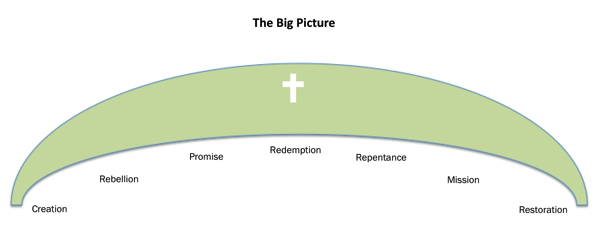
When thinking of God’s Big Picture, the great climax of all time will be God’s restoration of all things under Jesus Christ.

Screen Shot 2014 08 16 at 8 11 08 pm

We know what restoration is:

Taking something old or damaged, and bringing it back to its original condition. Last year I bought a 1925 Singer sewing machine. For several months I hid it in my shed, restoring it (as best I could) to its original state. It was a gift to my wife, and she loves it. My goal was to take the machine back to its former glory, and bring some delight to my wife in the process.

IMG 0782

Don’t you find yourself longing that the world would be restored? Back to it’s original condition? If you do, you’re like God. Because God is going to make all things right, restore his entire creation.

Interestingly, the idea of restoration does not seem to occupy the minds of many Christians. Most Christians talk more about their idea of heaven.

As it happens, one of the most popular books in Christian circles is a book called ‘Heaven is for real…’ This is the apparently true story of a 7yo boy who experienced heaven during an operation. He had wings, a harp, and found it a bit boring…

And fair enough. Does anyone find this picture appealing? Let’s just say someone invited you to a party, and one of the conditions was that it would be held in a public place, you would have to wear wings, play a harp, and move from one big pile of cotton wool to another while singing songs of praise. Is it a party you would want to attend?

So, are we surprised that there is a degree of ambivalence about heaven? If we’re not sure about heaven, how can we expect people to want to go?

The fact is, the Bible never talks about people in heaven having wings and harps, flitting from cloud to cloud while singing a selection of traditional hymns. So, what does the Bible say about heaven? About this restoration God will bring through Jesus?

Heaven, Restoration and Scripture

In the NT, ‘heaven’ is shorthand for the place where God rules. In the sermon on the mount, and in the NT parables, Jesus often refers to the ‘Kingdom of Heaven’ as the place where the will of God is done on earth, where God’s rule is recognised:

• Where God’s commands are lived graciously (Matt 5:19)

• Where greatness is measured in servanthood and humility (Matt 18:3)

• Where justice and mercy dominate all human relationships (Matt 18:23-35)

• Where there is peace between all people (Matt 5:3-10)

The Kingdom of heaven is seen wherever the curse is undone and sin overcome (Col 3:1-17). It is seen as God’s people live his ways, announcing his good news, and living his new good.

We know that until Jesus returns, the efforts of his people to live his new life will be imperfect and incomplete. Even so, such efforts are natural and normal for those people in whom Jesus lives by his Spirit.

The second thing we note about ‘heaven’ in the Scriptures is that the emphasis is not primarily on what God’s people receive, but on God’s acts to restore of all things.
God’s Big Picture is to bring this restoration completely, powerfully, wonderfully and eternally through Jesus Christ the Lord. So much so that human rebellion, sin, grief and the fall will be completely done away with forever.

The total work of Christ is nothing less than to redeem this entire creation from the effects of sin … God will not be satisfied until the entire universe has been purged of all the results of man’s fall. [Anthony Hoekema, The Bible and the Future, p.275]

God’s restoration will be universal and cosmic in its scope, including all reality, physical and spiritual.

There are some important considerations here, and the first is that when heaven, God’s restoration of all things, is in view the Bible does not speak about the removal of physical reality. This is surprise to many people in the western world.

The reason many think that heaven will a disembodied existence, with harps and wings and clouds is not because they have been influenced by the Bible, but because they have been influenced by ancient Greek thought. Greek gnostic thinking held that the closer to got to the divine, the more physical things would be left behind, and the more spirit focussed we would become.

Admittedly, we do have references like 2 Cor 5:8, which talk about being away from the body and at home with the Lord. But these refer to the spiritual state believers enter on death, before Jesus’ return.

The ‘heaven’ we are talking about today is the heaven after Jesus has returned and restored all things when all creation will sing “To him who sits on the throne and to the Lamb be praise and honour and glory and power, for ever and ever!” (Revelation 5:13, NIV)

The restoration to come under Jesus is not the destruction and removal of everything physical, but the destruction and removal of everything sinful and fallen. So, when we read about the earth being purged with fire (2 Pet 3) we are not reading about the destruction of the earth because it is physical. We are reading about the cleansing of the earth that is opposed to Christ and his rule.

In the language of the NT, heaven cannot be a place of disembodied existence. We see this first and foremost in the resurrection of Jesus. Jesus was not raised simply as soul or spirit, but as a complete ‘true man, true God’ person: body, soul, spirit.

This is the truth confessed all through the ages:

I believe in the Holy Spirit
the holy catholic church
the communion of saints
the forgiveness of sins
the resurrection of the body
and the life everlasting

[The Apostles’ Creed]

NT Wright observes:

If the resurrection is an event that actually occurred in time and space, as well as in the material reality of Jesus’ body, it has implications for other events that must follow.

Indeed it does. Christ’s physical, bodily resurrection is the first fruit of restored reality. The entire universe, recreated.

Finally, the NT teaches that when Jesus returns, his restoration will involve the coming together of heaven and earth.

The Apostle John sees this vividly:

“Then I saw “a new heaven and a new earth,” for the first heaven and the first earth had passed away, and there was no longer any sea. I saw the Holy City, the new Jerusalem, coming down out of heaven from God, prepared as a bride beautifully dressed for her husband. And I heard a loud voice from the throne saying, “Look! God’s dwelling place is now among the people, and he will dwell with them. They will be his people, and God himself will be with them and be their God. ‘He will wipe every tear from their eyes. There will be no more death’ or mourning or crying or pain, for the old order of things has passed away.”” (Revelation 21:1–4, NIV)

It is nothing less than the coming of an entirely transformed existence, a new universe:

“Then the angel showed me the river of the water of life, as clear as crystal, flowing from the throne of God and of the Lamb down the middle of the great street of the city. On each side of the river stood the tree of life, bearing twelve crops of fruit, yielding its fruit every month. And the leaves of the tree are for the healing of the nations. No longer will there be any curse. The throne of God and of the Lamb will be in the city, and his servants will serve him. They will see his face, and his name will be on their foreheads. There will be no more night. They will not need the light of a lamp or the light of the sun, for the Lord God will give them light. And they will reign for ever and ever.” (Revelation 22:1–5, NIV)

In this restored creation, all sin is gone, the curse has been conquered, and the tree of life – once barred to humanity in Eden – is now fully available to all.

John adds:

“I did not see a temple in the city, because the Lord God Almighty and the Lamb are its temple.” (Revelation 21:22, NIV)

In the Old Testament, the Temple was a sign of God’s presence with his people. But in God’s restored reality, God’s presence does not need to be signified, because he is with his people at last, and they are with him.

What God started in a garden, He recreates to become a city of light. It is a glorious climax to the life restoring redemptive plan of an all loving and all powerful God – praise His Holy Name!

That the new heavens and the new earth has this physical aspect is troubling to some, and the question naturally arises whether all this physical imagery is just symbolic.
The problem with the symbolic approach is that Scripture is replete with this picture, and some of the most stunning examples are found in Isaiah 60.

We read of a place which will be visited by nations and kings,

Of seas, and boats. Of herds of livestock,

Where exiled peoples come home to a place of freedom and splendour,

Were there is such safety that doors stay open and locks are thrown away

Of glorious natural beauty and majesty

Where violence is non existent

Where the weak are strong and the insignificant are lifted up in honour.

And just in case we doubt whether this could ever happen, the chapter finishes with an eyeball to eyeball guarantee:

“…I am the LORD; in its time I will do this swiftly.”” (Isaiah 60:22, NIV)

So, God’s restoration will reunite heaven (where God dwells) and earth (where humanity dwells).

“And I heard a loud voice from the throne saying, “Look! God’s dwelling place is now among the people, and he will dwell with them. They will be his people, and God himself will be with them and be their God.” (Revelation 21:3, NIV)

The enmity and separation brought by human rebellion and the fall, the alienation of humanity from God will be completely overcome! Eden is gloriously restored, and everything is ‘very good’ for all eternity.

This is where we are headed, friends! This is the great plan of God: once for all to deal with human sin and rebellion, and restore all things to their rightful place in and under Christ. This restoration is focussed on the glory of our great God and the overwhelming victory he will bring. Those who once were rebels, now raised in Christ, will rule on his new earth, and the glory of the Lord, the profound peace of God – His Shalom – will rule from sea to sea.

Imagine…

Marriages without arguments (I know Jesus says people will neither marry nor be given in marriage – but you know what I mean: harmonious life, peaceful relationships, no more misunderstandings).

No more depression or mental illness.

No more guns and war.

No more fear at night.

No more terror. No more hatred.

Imagine no possessions
I wonder if you can
No need for greed or hunger
A brotherhood of man
Imagine all the people
Sharing all the world…

[John Lennon, 1971]

It’s such a deeply help human wish, that even those far from God find themselves dreaming about it.

Living in the ‘not yet’ with our eyes on God’s forever

God’s restoration of heaven and earth is the ultimate reason to live for him and praise him! This vision draws us into a rich hope, a hope which the Bible says, does not disappoint. It is the best motivation to trust God, to offer him our heart, to ask him to rule our lives!

But we are not there yet. This is why we are people of faith and hope. Following Jesus does not take us out of the world: it send us into it. Not to adopt its values, but to transform them (Rom 12:1-2).

CS Lewis once said “Aim at heaven, and you will get earth thrown in. Aim at earth, and you will get neither.”

What he is saying is we will only find fulfilment as the values of God’s new creation shape everything we do. As new creation we announce the good news and we live the new good.

How important for us to do this! We have seen much terrible news these last weeks. Whole groups of people, some of them Christians, gunned down by ISIS extremists.

ISIS believe their task is to extend the Kingdom of Allah by force. Use guns and swords and tanks to subjugate people. And those who do not comply, put them to death. That kingdom expands through terror, bloodshed and fear.

God’s Kingdom, God’s restoration, does not come by terror, or violence or human power. It comes by resurrection, selflessness, and the spirit of the servant, Jesus.

God’s Kingdom, God’s restoration, does not come by terror, or violence or human power. It comes by resurrection, selflessness, and the spirit of the servant, Jesus.

“…Not by might nor by power, but by my Spirit,’ says the LORD Almighty.” (Zechariah 4:6, NIV)

Jesus’ rule is extended by grace and love. Through the sacrifice of the cross, and the resurrection life of Jesus coming to expression as he rules human lives. While we wait for the ultimate restoration, we live its life now. Doing God’s will on earth as it is in heaven so people everywhere will see men, women, children, communities changed by Jesus.

“No longer will they build houses and others live in them, or plant and others eat. For as the days of a tree, so will be the days of my people; my chosen ones will long enjoy the work of their hands. They will not labor in vain, nor will they bear children doomed to misfortune; for they will be a people blessed by the LORD, they and their descendants with them. Before they call I will answer; while they are still speaking I will hear. The wolf and the lamb will feed together, and the lion will eat straw like the ox, and dust will be the serpent’s food. They will neither harm nor destroy on all my holy mountain,” says the LORD.” (Isaiah 65:22–25, NIV)

This is God’s Big Picture. This is the core message of Christianity. In Jesus, God is dealing with human rebellion, our alienation from our creator, the brokenness of our world. In and through Jesus God will restore it all. Read to the end of the book, and you will see that we win.

This is the reality we are headed toward. There are may questions. Some we can answer, some we cannot answer. The biggest question of all, however, is this: Will you be there?

Jesus declares to us and assures us that he is the way, the truth the life. Anyone can come to the Father through him.

This glorious restoration, the glory of God, is reason alone to do just that. To trust him, to honour him, to live for him.

Mission (Foundations #6) – Group Questions

Discussion Questions relevant to Foundations #6 – Mission

Starters: What is the first thing you think about when you hear the word “mission”?

Read: Isaiah 42:6, Matthew 28:16-20

What do you think about the assertion that all efforts of every Church should serve the mission of God?

“It is not the people of God who have a mission in the world, but the God of mission who has a people in the world” [Martin Robinson]

Read Exodus 19:3-6 and 1 Peter 2:9-12, and discuss “God has always been focussed on his mission.”

The mission God has given to the church has two components: announce the good news, and anticipate the new good. Which component receives more attention in your church? Should this be corrected? If so, what would need to happen?

What aspects of life in your local community would benefit most from Christians announcing God’s good news and anticipating God’s new good more effectively?

What concrete steps can your group take to bring these things to expression?