Dealing with Disaster (Group Questions)

Discuss:

Share your thoughts about how the tragic events of the last few weeks have impacted you. How have these events influenced your prayer life?

Read Lord’s Day 10 of the Heidelberg Catechism: What strikes you about this personal assertion of God’s providence?

Read Psalm 46

Think of a time when life was hard for you or your loved ones. Was it apparent that God was your fortress? What impact did this have – positively or negatively – on how you managed that challenge?

What would the writer of Psalm 46 have to say to those who hold that God’s blessing is measured in health, wealth and prosperity?

In times of tragedy and trial we will often say ‘God will work things out for our good.” Is this what Romans 8:28 actually says? Who are the “those” in the phrase “the good of those who love him”?

What does Genesis 50:15-21 tell us about divine sovereignty and human responsibility?

Are you ‘a person of the problem’ or a ‘person of the solution’? How is this seen in your behaviour?

Read Matthew 5:13-16. List the things your church is doing to be ‘a community of the solution’ addressing suffering in your local community.

Read the full text of “Dealing with Disaster: Where is God in tragedy?” here

Redemption (Foundations #4) – Group Questions

Read 2 Corinthians 5:11-21

Discuss

What makes the church in the western world so resistant to the message of weakness and sacrifice so clearly displayed in Jesus’ ministry?

What reasons would we have to say that the manner of Jesus’ sacrificial ministry should be reflected in the church’s ministry and mission today? What challenges does this present to your church or your Christian community?

The redemption God has worked through Jesus impacts on three key areas of existence: People and their relationship with God; People and their relationship with others; People and their relationship with their environment/creation. How does this challenge how you see your world? What specific changes does it demand in your life?

“Therefore, if anyone is in Christ, the new creation has come: The old has gone, the new is here!” (2 Corinthians 5:17, NIV) – in your opinion, which Christians or Christian movements have been the best expressions of this truth?

2 Cor 5:21 says your sin, guilt and rebellion have been laid on Jesus, and his righteousness has become yours. What does this mean to you personally?

Christians have been very influential in the development of western culture. Which areas would most benefit from Christian leadership and challenge in your part of the world?

What particular attitudes or behaviours is God calling you to change as a result of these truths?

Spend some time praying for one another, or praying for your Christian friends, asking that God’s new creation in Jesus might come to beautiful expression in their lives.

Redemption (Foundations #4)

Read: 2 Corinthians 5:11-21

A few years ago I had a bit of a supermarket windfall. I’d walked into the meat section at Woolworths looking for some minced beef. I always look around for good specials while I’m there, so I was checking some prime bone-in rib steak.

They were about 50mm thick. They were MSA graded. Typically $39.00kg. And guess what else? They had been priced as economy grade mince. Like $7.99kg.

What do you think I did?

How happy do you think I was?

How good do you think they tasted?

Some years ago Tony Campolo got us all to imagine that one day all the supermarket price tags had been switched, where the best steaks would be a dollar or two, and the mince would be $50kg. Or the new Landcruiser would cost $900 and the rustbucket Daewoo $85,000.

The point was that in the Kingdom of God, the world’s typical values are reversed, turned on their head. The last will be first, and the first will be last. Power is made perfect in weakness, and so on.

How God rescued his world

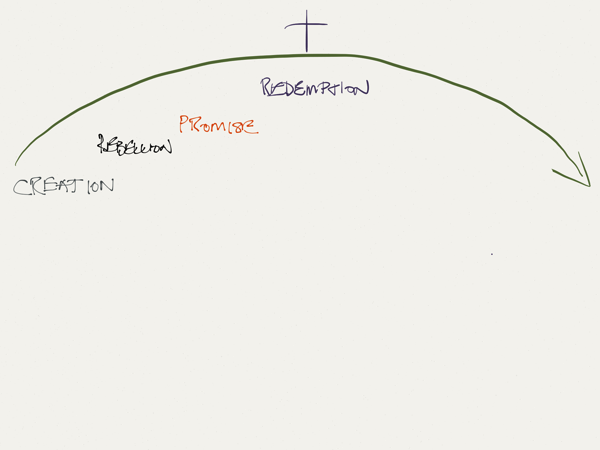
This is, in fact, how things are. We learn this from the big picture of what God is doing.
IMG 0181

We have seen how he created, how humanity rebelled and plunged the universe into the fall, how God promised to restore all things and crush the head of evil.

Today we will see how God is bringing this rescue about, how he is bringing redemption.
We will see that this rescue is something like the switching the price tags metaphor because this rescue is altogether different, wonderful and – from a human standpoint – extraordinary and remarkable.

6147c054 bfc5 11e3 589366b

Think of it this way. We all know who this little boy is (Prince George). At present, he’s much like other one year olds. He’s got a few teeth. He’s starting to walk. And while he’s a member of the royal family, he has no idea how to plant trees. He still poops his pants.

But all things being equal, one day this will change. This little toddler will become King. And what will change?

His clothes will change: he will wear the robes and finery of a King.

His address will change: Windsor Castle, and Buckingham Palace.

He will wear a crown, studded with priceless jewels.

He will have attendants, and crowds will cheer him on, and as he walks in parade people will oooh and aaah as he passes by. When a man becomes King, this is what happens.

But what really interests us today is: what happens when God becomes King? Any of that?

What do we see in Jesus?

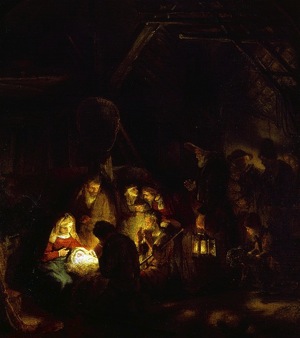
An unmarried mother, rumours of cheating, and mention of divorce. We see a shed, with straw, and a manger. A naked baby. A cow. Some chickens. And the visitors are shepherds, a dodgy underclass of near homeless people with a cheeky taste for mutton.
Nat3 1791716b
Rembrandt: The Adoration of the Shepherds, 1646

The moment we see this, we begin to understand that the rescue God is bringing is altogether different to what we might expect.

God’s Plan of Redemption: The Cross

The New Testament Gospels – the biographies of Jesus’ birth, life, ministry, death and rising again – confirm this. The people of Jesus day lived in a Roman province called Judea. Their once great nation had been conquered by a series of world powers. Assyria (722BC). Babylon (586BC). Greece (198 BC). And then Rome (37BC).

The people of Jesus’ day had heard God’s promises in the Hebrew Scriptures, and believed God would send mighty warrior King to boot out the invaders, and return Israel to her former glory.

Then, here comes Jesus. Feeding thousands, healing the sick, opening the ears of the deaf, giving sight to the blind, healing the paralysed, and raising the dead. No small wonder how Jesus’ contemporaries want to make him King.

Evens so, he consistently avoids pressure to become a military or political figure. He consistently challenges the religious leaders of the day. Jesus becomes too popular. The religious leaders get too threatened. So they conspire to put him to death on a cross.

Interestingly, when Jesus was crucified, we read that Pilate, the Roman Governor, attached a notice on Jesus’ cross which read ‘this is the King of the Jews.’

Did you realise Pilate was a prophet?

Did Pilate know that his act of antagonism in appending the notice to the cross, he expressed one of the greatest truths of all time: this is what it looks like when God becomes King.

God’s promise of redemption, God’s rescue of people, their world, their cosmos, would be fulfilled as God himself, the King, expends himself, sacrifices himself, as Jesus, True God and True Man, goes to the cross so his people might truly live and their world might truly be restored.

Here is the truth about God’s redemption: it comes through the crucified and risen Jesus. Through Jesus God is reconciling all things to himself (see Colossians 1:20)

The Context for Redemption

We saw a few weeks ago that human rebellion affected three key areas of existence. This rebellion, this sin, brought division between

People and God

People and one another

People and their environment

What we see today is that the redemption God has worked through Jesus Christ his son actually impacts each of those contexts.

First: Jesus brings redemption from the domination of sin on human disposition. This is clearly outlined by the Apostle Paul in Romans 8:1-4

“Therefore, there is now no condemnation for those who are in Christ Jesus, because through Christ Jesus the law of the Spirit who gives life has set you free from the law of sin and death. For what the law was powerless to do because it was weakened by the flesh, God did by sending his own Son in the likeness of sinful flesh to be a sin offering. And so he condemned sin in the flesh, in order that the righteous requirement of the law might be fully met in us, who do not live according to the flesh but according to the Spirit.” (Romans 8:1–4, NIV)

Jesus sets us free from the law, the rule, the dominion of sin and death. Jesus breaks the power of rebellion to rule human nature.

God’s redemption deals with our sin, and draws people back into relationship with God

“God made him who had no sin to be sin for us, so that in him we might become the righteousness of God.” (2 Corinthians 5:21, NIV)

Our sin and rebellion is laid on Jesus. His righteousness and faithfulness is given to us. This change is so powerful that it is described as an act of re-creation:

“Therefore, if anyone is in Christ, the new creation has come: The old has gone, the new is here! All this is from God, who reconciled us to himself through Christ …” (2 Corinthians 5:17–18, NIV)

Make no mistake: Jesus death on the cross and rising again deals with the rebellious disposition of people!

Second: Jesus’ redemption brings healing and restoration to human relationships:

There is hardly an uglier enmity on the pages of the Bible than the enmity and hatred between Jews and non Jews. Think: Israel and Palestine today and you’re pretty much there.

Israel palestine

But listen to what Paul writes to non Jewish people shortly after Jesus’ rising again:

“Therefore, remember … that at that time you were separate from Christ, excluded from citizenship in Israel and foreigners to the covenants of the promise, without hope and without God in the world. But now in Christ Jesus you who once were far away have been brought near by the blood of Christ. For he himself is our peace, who has made the two groups one and has destroyed the barrier, the dividing wall of hostility, by setting aside in his flesh the law with its commands and regulations. His purpose was to create in himself one new humanity out of the two, thus making peace, and in one body to reconcile both of them to God through the cross, by which he put to death their hostility…” (Ephesians 2:11–18, NIV)

As we see this violence and hatred played out before us in media reports of tensions between Israel and Palestinians in Gaza, we must recognise that the greatest need of all is for Jesus’ to rule the hearts and lives of men and women. More than international diplomacy, more than political deals, our world needs the reconciling peace which Jesus brings. Jesus brought unity between Jew and non-Jew in the first century. We need to pray he will do the same again.

Third: Jesus’ redemption opens the way for the restoration of all things.

Creation, groaning under the weight of the fall, cries out for the full redemption to come when Jesus returns to complete his work:

“For the creation waits in eager expectation for the children of God to be revealed. For the creation was subjected to frustration, not by its own choice, but by the will of the one who subjected it, in hope that the creation itself will be liberated from its bondage to decay and brought into the freedom and glory of the children of God.” (Romans 8:19–21, NIV)

The redemption God brought through Jesus’ death and resurrection impacts on it all:

People and God

People and other people

People and creation, creation itself

Here’s a question for you: Had you considered that the death of Jesus on the Cross and the power of his resurrection guarantees the resurrection of people, of society, of our world?

Did you realise that God’s plan is so mind bogglingly comprehensive?

So incredibly powerful?

You might say, ‘well, I don’t know about that. I haven’t seen too much change in people or the world. I certainly haven’t seen anything that transformational or redemptive!’ And you may be right. Perhaps you have not seen that.

You may not have seen the sheer number of societal developments spearheaded either by the church or by people who were walking with Jesus.

The development of public schools.

The development of hospitals and compassionate care.

The early days of the union movement.

The end of the slave trade under Wilberforce.

The invention of the Cochlear implant by Graeme Clark

Cancer immunology, advances in mesothelioma, through Professor Bruce Robinson, West Australian of the year in 2014

The challenge to segregation under Dr Martin Luther King.

The challenge to Nazism through Bonhoeffer.

The list is long, though quite possibly you might not be aware of how the Risen Jesus worked through such people. (A good place to see how much impact the kingdom of Jesus has had on western society is the writings of Rodney Stark)

Even if you are not aware of these people and how their lives honoured Jesus, there’s another context in which God’s redemption comes most powerfully to expression. You might not have seen that either, even though you really should have. That particular context is your own life.

If anyone is in Christ, new creation has come! They are new creation! In Jesus, you are new creation! As a follower of Jesus, you are the context in which God’s new creation will come to expression. This is the thing: God’s redemption comes powerfully to expression in the world as he brings change in people’s life, in your life, in mine.

If anyone is in Christ, new creation has come!

It always amazes me that some Christians in particular can be so critical, looking down their noses and bad mouthing others for their faults and failings, using that as reason to disengage or not be involved in what God calls them to do. They miss the point that the first context they should see the transformational power of God rescue is in their own lives!

God wants his new creation to come to expression in their behaviour and attitudes. God’s Spirit intends for you to

Break the pride.

Stop the whinging.

Cut the gossip.

Stop the cheating on your partner.

Stop driving like a hoon.

Keep you anger in check.

Lose the holier than thou attitude.

See, God has little interest in you just changing your ideas, listening to Joyce Meyer or Driscoll or Keller or whomever. You can be as eloquent as you like about the views of such speakers, or the books you read. But it all means zip unless your life starts to come under Jesus’ rule (more to say about that next time).

Let’s just say for today the work of the Spirit in you is to redeem you. To restore Christ’s character and attitudes in you. To overcome rebellion in your thoughts, words and actions. To bring new creation to expression right there in your life! God made him who had no sin, to be sin for you, so that in him you might become the righteousness of God!

God wants this change, this new creation, to move from your mind, to your heart, to your hands and your life.

if everyone who went by the name of Jesus actually started to live like Jesus, would our world be any different?

Did not Jesus say, “Therefore everyone who hears these words of mine and … puts them into practice is like a wise man who built his house on the rock.” (Matthew 7:24, NIV)

Let me ask you, if everyone who went by the name of Jesus actually started to live like Jesus, would our world be any different?

If you started to live like Jesus, really, would your family be any different?

Your workplace?

Your local community?

It is inconceivable that any of these contexts would stay the same when people commit to living out Jesus’ new creation.

The character of Redemption

I want to push a little harder to get us thinking about the character of Jesus’ rescue and redemption, or – in the language of the Gospels – the character of the Kingdom.

Remember that Jesus was a picture of weakness when he was born. Remember how he refused to pander to the expectations of the people of his time, and how he rejected all pressure to be a political messiah? Remember how he was an object of foolishness when he died on the cross?

Now, if Jesus came in that manner, lived in that manner, died in that manner – don’t you think there are implications for how we should be living?

Don’t you think this is a powerful statement of what Christians should aspire to?

Doesn’t that impact the kind of life you lead?

The kind of future you seek?

The kind of success you aim for?

What sort of ministry we should want to develop?

Does that impact on what sort of church we should be trying to grow?

There is so much pressure on western churches to strive to be large, to focus on building the biggest and most impressive. We see many mega-churches focussing on the trinity of ‘lights, camera and action’ and using these means as their primary drawcard. In the end such emphases become harder and harder to maintain. The reason is that we’re imitating the world, and the world always does ‘the world’ better than the church.

Christ’s call on us is to be distinct, unique, an alternate and contrasting community. To display the impressive reality of the Gospel, even if the message appears to some as foolishness. The power of the risen Christ ruling a community of his people will always have more transformational impact that anything else.

This is what we should be looking for and working toward. Through history, this has tended to mean churches working in smaller, more community oriented units as compared with large mega churches. Historians and church growth experts will show us that these smaller units have greater missional effectiveness in impacting the local community. So maybe it is is true that small is the new big.

These are some of the most strident challenges to the prosperity Gospel: where all God wants to do is give you riches and wealth and success. What a joke! Jesus and the early church had none of that!

It was quite the opposite: where people had excess wealth, they sold some of their stuff and gave the money to anyone in need. There’s redemption and restoration right there friends.

These are some of the most incisive challenges to comfortable churches of convenience.
Where nice people roll up to get a religious ‘sugar fix’ hoping to walk away sated for another week.

This rescue, this redemption God has brought through his son is the most radical, transformational, anti establishment movement on the face of the earth! Through this Jesus centred redemption

God brings change in human disposition and behaviour.

God brings restoration in relationships

God brings hope to a fallen bruised and broken world.

And the primary context for his change to come to glorious expression is in your heart, my heart, in new community right here, right now.

Promise (Foundations #3) – Group Questions

What has been the most memorable promise someone has ever made to you? How did it change your behaviour or the course of your life?

Do you agree that God’s most basic response to human rebellion is one of grace and promise? How might the Christian Churches bring this to better reflection in their mission and ministry?

God’s promise of restoration is directed to 1) the human heart, as he promises to deal with human sin and rebellion 2) human relationships, as he promises to reconcile people to one another, and 3) all created reality, as he promises the new heavens and the new earth.

* Which of these areas has tended to receive the most focus in Christian teaching? Does this perceived emphasis reflect the fullness of the Bible’s teaching?

* How could Christians and the Christian Church conduct themselves differently so as to address this perceived imbalance?

God’s plan of salvation is as concerned with physical realities as it is with spiritual realities.

* How does this truth challenge or comfort you?

* What challenges does this present to you church, or to how you live as a follower of Jesus?

Who, in your experience, has been the greatest example of how the message of Jesus brings holistic transformation to all of life?

Foundations – #1 Creation – Small Group Questions

Foundations – #1 Creation

Gen 1 – 2:3

Home Group Study Questions

“Creation is as historically real as the history of the Jews and our present moment of time. Both the Old and the New Testaments deliberately root themselves back into the early chapters of Genesis, insisting that they are a record of historical events” – Francis Schaeffer

• Comment

What accounts for the pressure to read Genesis 1 through the eyes of 21st Century evolutionary ideology?

• What are the best ways to counter this pressure?

Do you think it is possible for a person to be a Christian and still accept evolution?

Which has the greater authority: western science or the Bible? Are there ever instances where we should accept the voice of science over what the Bible says?

Read Col 1:15-23. What reason would Paul have had to start this section with an assertion grounded in the eternal nature of Christ?

“If God is creator, you as a creature are accountable to him” What are the key implications of this reality?

What advantages are there in referring to creation when sharing the Gospel with others?

Foundations #1 – Creation

[This is the first in a series of sermons outlining the basic Christian message. The Foundations series is being presented at Gateway Community Church from June 2014]

Reading: Genesis 1:1 – 2:3

In the beginning…

There are seven Hebrew words which lay claim to our lives:

בְּרֵאשִׁ֖ית בָּרָ֣א אֱלֹהִ֑ים אֵ֥ת הַשָּׁמַ֖יִם וְאֵ֥ת הָאָֽרֶץ׃

Bereshit bara Elohim et’ ha’shamayim w’et h’aretz

These are first seven words of the Old Testament. They are the most profound explanation of who we are, and where we have come from. They are the ground of all we now about God, our world, and what God is doing in our world.

If we want to understand Christianity, if we want to have the best foundation to understand the message of Christianity, this is where we start.

In the beginning, God created the heavens and the earth.

From a Christian point of view, there is no other way to understand the universe than to say ‘God created it’.

We all know there are differences of opinion here. Six day creation. ‘Long day’ creation. Theistic evolution. Full on evolution. And a myriad other positions across that spectrum.

Just so I make myself perfectly clear, I want to make the following statements very directly.

• I am a card carrying creationist

• I am not a theistic evolutionist

• There is no way to harmonise the larger scheme of evolution with the Biblical assertion of creation.

• Creation is not a myth. It is reality

Creation is as historically real as the history of the Jews and our present moment of time. Both the Old and the New Testaments deliberately root themselves back into the early chapters of Genesis, insisting that they are a record of historical events

– Francis Schaeffer

Having said that, we need to understand some important things about Gen 1. The author of Genesis wrote so the people of his day would understand their origins. Genesis is ancient writing for an ancient people.

The implications are obvious. The author did not intend for his writings to be understood in 21st Century scientific categories. If he did, his writings would not have been understood by his original hearers. So we need to be careful about reading our science and our 21st Century worldview back into these words.

There is great pressure to do this. Many Christians want to prove that creation is scientifically defensible. And while it’s good to understand these verses as best we can, when we try to force them into western scientific categories, we admit that unless we can do that, they are open to question. And by doing that we make God’s word dependent on western scientific theory.

God’s word, however, stands above science. Ultimately, science cannot contradict God’s word, because if there is any truth in the world, any truth at all, it is because the God of truth has put it there. And where we cannot harmonise what science says with what God says, we continue to seek answers, but also admit the failings of our own minds.

Competing views of creation are not inventions of our secular age. They have always been there. Even when these words were first written, the Canaanite peoples also challenged the truths in Genesis 1. Those other creation stories saw the world coming into existence through cooperation between the various gods, or it involved conflict among them; the world coming into being as a result of arguments and fights among the gods.

In contrast, Genesis 1 tells the Israelites that it actually came into being as a result of the cool, planned, systematic, sovereign activity of God so that “the heavens and the earth” are one “cosmos,” one coherent whole.

In the beginning, God created the heavens and the earth.

This we believe.

But if it’s all we believe, we only have a portion of the story.

Accountability

The Bible gives us an additional angle: God did this work of creation through his Son, through Christ.

So it’s not just creation that messes with our independent mindset. It’s also that the divine Son, even before he took on humanity, is the agent of creation.

The Bible says

“In the past God spoke to our ancestors through the prophets at many times and in various ways, but in these last days he has spoken to us by his Son, whom he appointed heir of all things, and through whom also he made the universe.” (Hebrews 1:1–2, NIV)

“The Son is the image of the invisible God, the firstborn over all creation. For in him all things were created: things in heaven and on earth, visible and invisible, whether thrones or powers or rulers or authorities; all things have been created through him and for him.” (Colossians 1:15–16, NIV)

“In the beginning was the Word, and the Word was with God, and the Word was God. He was with God in the beginning. Through him all things were made; without him nothing was made that has been made.” (John 1:1–3, NIV)

God created the universe through his Son.

There is a confronting implication to this: As creatures we are accountable to our Creator.

Think of it this way: when you’re at work, to whom are you accountable?

So, if the boss says “I want you to do this today” you have to do it. You’re not free to do whatever you want, even though it might be a smashing good idea. Of course not. Your responsibility is to do what the boss says.

Or imagine you have a car, and you’re down at the river, and you think, “I’m sick of driving on these roads, I want to drive in the river.” So you drive down the boat ramp, and away you go. Or, down you go. Unless you are driving one of these [amphibious Lotus Esprit – from the 1977 James Bond film, “The Spy Who Loved Me”]…

Here’s the point: You must use the car within its specifications. If you don’t, you could wreck your car. And you might die.

In the same way that you are accountable to the boss: he owns the workplace, and your accountable to do what he says by reason of the fact that you are his employee,
so also: You are accountable to God. He created you. He created your world. He created your universe. It belongs to him. You belong to him. You are on his time, and in his place.

Also, in the same way that you must use your car in accordance with its specifications, you are called to live and operate according to the maker’s instructions. According to what God says. Otherwise you could wreck your life, or die, or both.

God is creator, and you are accountable.

Very few people enjoy coming face to face with this truth. But their lack of enjoyment, or even their rejection of that truth does not determine whether that truth is true. You don’t have to understand or accept something to make it true.

Like gravity. You don’t have to understand it, or even believe it to make it real. I don’t get the physics. But every time I step onto a plane, I know that things work to keep the plane in the air. And if foursome crazy reason, the next time I am on a plane, I go crazy and jump out, it won’t matter whether I believe in gravity or whether I understand it, I will still end up a mangled blob on the ground.

Like gravity, creation is an objective reality. It is true whether you accept it or not.

When Paul spoke to the philosophers on Mars Hill, he presented objective realities. Few people accepted what he said. Others mocked. It made no difference to the truth expressed.

“The God who made the world and everything in it is the Lord of heaven and earth and does not live in temples built by human hands.” (Acts 17:24, NIV)

“God did this so that they would seek him and perhaps reach out for him and find him, though he is not far from any one of us. ‘For in him we live and move and have our being.’ As some of your own poets have said, ‘We are his offspring.’” (Acts 17:27–28, NIV)

Hope

So: God is Creator. The first implication is that you are accountable.

There is a second implication to this truth.

Because this sovereign God created the heavens and the earth, because he rules them, we can have hope that things are not random and out of control. God’s creative act brought order and beauty out of chaos.

I know there is the additional question of, when God’s work of creation was ‘very good’, how come it is not very good now?

Why are there natural disasters, human violence and corruption, disease, pain, and grief. I will start to address these questions next week.

But for now, there is comfort that this same creator God is still working to bring order out of chaos. His plan is to restore his creation and humanity to its perfect and glorious state. That is a wonderful hope.

You don’t have to be a particularly religious person to see that there’s something wrong with the world, and that it should be better.

You don’t have to be particularly negatively minded to know that there’s something wrong with your life, that not all things are right with you, that you should be better, or different, to what you are. Sure, we might have a sense of powerlessness about being able to change, or grow, or do things differently. But that does not stop us yearning for it.

The Good News is we can call on this creator God, on the Son through whom we, our world, and everything in it were created, for help.

Christ the light can shine into our darkness.

If your life is dark and desolate, if your life is out of control, if there is no light in your life, but only darkness, and there seems to be no hope — turn to this Creator God!

Christ the Creator, can bring order out of our chaos.

If your life is a mess, if things are upside down, if everything has gone to custard, you can call out to this God who created all things through His son.

Call out to the Son for help.

Call out for him to bring order to your life.

If Jesus Christ can bring order to a formless creation, he can do the same in your life, can’t he?

This is his work. This is what he loves to do!

That is good news!

And it comes through Christ the Creator!

In the beginning God created the heavens and the earth.

Today, God seeks to re-create your life. In Jesus he has the desire, the power, and the opportunity to do so. The very same power that flung the stars out into the unfathomable, expanding universe while orchestrating life in the irreducible complexity of the cells of your body will act on your behalf when you turn to him (Kent Hughes).

Knowing what we do, it sounds almost unbelievable that the Creator of the universe would give any thought to you, your life, your future, your needs.

But this is what he says.

“Come near to God and he will come near to you. Wash your hands, you sinners, and purify your hearts, you double-minded.” (James 4:8, NIV)

“…Jesus declared, “I am the bread of life. Whoever comes to me will never go hungry, and whoever believes in me will never be thirsty … All those the Father gives me will come to me, and whoever comes to me I will never drive away.” (John 6:35–37, NIV)

He will turn your night into day through his word.

He will reorder your broken life through his word.

He will bring form out of chaos through his word.

New Series – Foundations 2014

Foundations 2014 Postcard  lite2

This is a new series of sermons I am writing to give people an overview of Christianity. It is intended to be an introduction, not an exhaustive treatment. My prayer is that these will be an encouragement to readers, and possibly even helpful for those who might need to present a sermon somewhere and not have the time to prepare anything.

More than happy to receive feedback or questions. I do not claim the last word. We are all learners, and I am happy to learn about God’s goodness and grace with you.